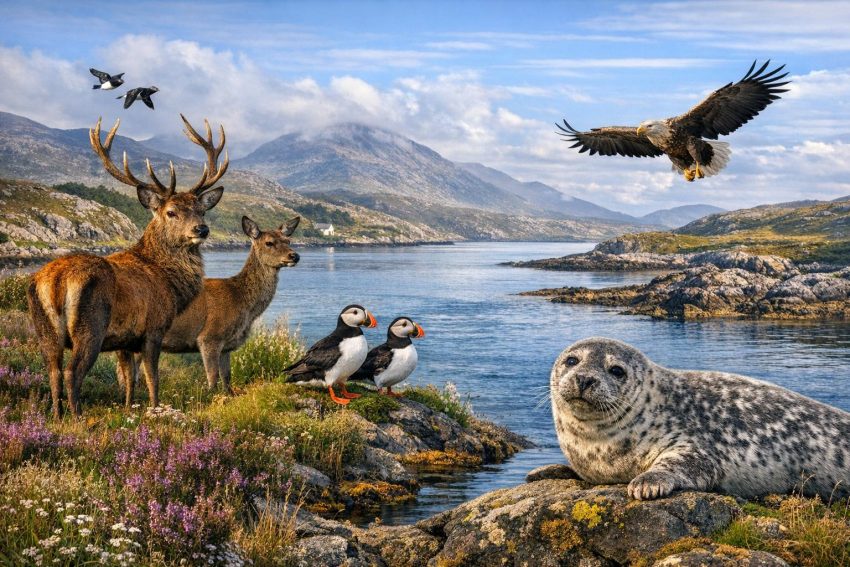
The Isle of Scalpay lies off the east coast of Harris in the Outer Hebrides. Known in Gaelic as Sgalpaigh, the island covers about 10 square miles and has been connected to Harris by a road bridge since 1997. Its position between the exposed Atlantic weather of the Western Isles and the more sheltered Minch has produced a compact mix of rocky shores, sea lochs, peat bog, rough grazing, freshwater pools and small pockets of planted woodland.
Scalpay has few formal wildlife facilities, yet that is part of its value. Much of the island remains open, lightly developed and closely tied to the sea. Wildlife watching usually involves walking quiet roads, checking sheltered bays, scanning offshore rocks and spending time beside the coast. Patient observation tends to work better than covering a lot of ground. A still watcher often notices far more than a brisk walker.
Otters, seals, waders, seabirds and moorland birds form the main wildlife interest. Eagles and other birds of prey may pass over from Harris, while dolphins, porpoises and whales sometimes appear in the surrounding waters. The species visible on any visit depend on season, tide, weather and chance. Scalpay is not a wildlife park, after all; animals keep their own schedules.
Scalpay’s main wildlife habitats
The island’s wildlife is closely linked to its varied ground conditions. A few hundred metres can separate a salt-sprayed rocky shore from wet heath, peat bog or sheltered grazing. Each habitat supports a different group of plants and animals, and many species move between them during the day.
Rocky coastline and skerries
Rock dominates much of the coast. Low cliffs, exposed headlands, boulder beaches and offshore skerries provide resting and feeding places for seals, gulls, shags, cormorants and waders. Cracks above the tide line may offer nesting sites for wheatears and other birds, while lower rocks support limpets, barnacles, mussels and seaweeds.
The character of the shore changes with exposure. Headlands facing open water receive heavy waves and salt spray, so only firmly attached plants and animals can persist there. Sheltered inlets contain softer sediment, calmer pools and denser seaweed. These quieter sections often hold more feeding waders and may give better views of otters.
Sea lochs and sheltered bays
Sea lochs are productive feeding areas because their shallow water supports small fish, crustaceans and molluscs. Freshwater entering from burns can create brackish margins where marine and freshwater conditions meet. Redshanks, herons and gulls search these edges, while otters use submerged rocks and seaweed beds during hunting.
Calm bays are also useful places to watch for harbour porpoises. Their small, triangular dorsal fins may appear briefly before vanishing below the surface. On still days, the sound of a porpoise breathing can occasionally be heard before the animal is seen.
Peatland, wet heath and rough grassland
Away from the shore, much of Scalpay consists of acidic moorland, peat and wet grass. Heather, deer grass, cotton grass, sedges and rushes grow according to drainage and grazing pressure. Meadow pipits, skylarks and curlews use open ground, while hen harriers may hunt low above the vegetation.
Small pools and wet hollows support aquatic insects and provide bathing or drinking places for birds. They also hold moisture during dry spells, helping nearby plants and invertebrates. Peat ground can appear firm but may contain hidden channels and soft edges, so walkers should test uncertain footing rather than charging ahead.
Settlements, gardens and planted trees
Scalpay has little natural woodland, but gardens, shelter belts and planted trees broaden the range of available habitat. Dense shrubs provide protection from wind, nesting cover and insects. Blackbirds, wrens, robins, chaffinches and migrant warblers may gather in these sheltered pockets, particularly after poor weather.
Buildings also create nesting and roosting opportunities. House sparrows and starlings use gaps around roofs, while swallows may nest inside suitable sheds. Bats can roost in buildings and feed around gardens, burns and sheltered roads during warm, calm evenings.
Marine life around Scalpay
The Minch and the sea lochs around Scalpay contain rocky seabed, sand, gravel and beds of kelp. This mixture supports fish, crabs, lobsters, molluscs, starfish and many smaller animals. Marine life may not always be visible from shore, but it sustains most of the island’s better-known coastal species.
Kelp beds and shallow water
Kelp grows below the low-water mark where light can reach the seabed. Its long fronds provide cover for juvenile fish, prawns and crabs. Snails graze on algae growing across the kelp, while starfish and larger crustaceans hunt among rocks. Pollack, wrasse and other fish use these submerged forests for feeding and shelter.
Storms can tear kelp from the seabed and deposit it along the shore. The resulting piles may look untidy, but they have considerable ecological value. Sandhoppers, flies and beetles feed within the decaying vegetation. Turnstones, pipits and wagtails then search the strandline for those invertebrates.
Rock pools and the intertidal zone
Low tide exposes a strip of shore that spends part of each day underwater. Conditions here change quickly. Animals must cope with waves, drying, fresh rainwater and wide temperature variation. Barnacles close their plates to retain moisture, limpets clamp tightly to rock, and anemones draw in their tentacles until seawater returns.
Scalpay’s rock pools may contain shore crabs, hermit crabs, prawns, periwinkles, dog whelks, small fish and beadlet anemones. Brittle stars and young lobsters may occur beneath stones in suitable places. Identification often requires a close look, though animals should remain in the water whenever possible.
If a stone is lifted, it should be returned to the same position with care. Leaving it overturned exposes hidden animals to birds, sunlight and drying wind. Buckets and nets are rarely needed for casual observation. Looking into a pool from above causes less disturbance and usually reveals plenty once the water settles.
Seaweeds of the shore
Brown seaweeds are the most conspicuous plants along the intertidal shore. Bladder wrack can be recognised by paired air bladders, while channelled wrack grows higher on the rocks and tolerates long periods outside water. Serrated wrack has toothed edges, and kelp occurs lower down where it remains submerged for longer.
Green seaweeds often grow in pools or places enriched by nutrients. Red seaweeds tend to occur farther down the shore, though some tolerate exposed conditions. Together, these plants reduce wave force, retain moisture and create cover for small animals. Detached seaweed also transfers marine nutrients onto nearby grassland.
Otters on Scalpay
The Eurasian otter is one of the mammals most strongly associated with Scalpay. Otters in the Hebrides commonly feed in salt water, unlike many inland British otters that rely mainly on rivers and lakes. They hunt along rocky coasts, in sheltered bays and around kelp-covered shallows.
Marine feeding does not remove their need for freshwater. Salt left in the fur must be washed away, so burns, pools and wet ground near the coast matter. Otters may bathe in freshwater after hunting, then rest in dense vegetation, rock cavities or underground holts above the tide line.
How to recognise an otter
An otter swimming at the surface usually shows a broad head, low back and thick tail. The movement is smooth, and the body often appears longer than that of a seal. Otters may dive with a small arch of the back or lift the tail as they submerge. A seal tends to show a rounder head and may remain almost upright while watching.
On land, otters move with a low, rolling gait. Their tracks have five toes, though not every toe always registers in mud or sand. Spraints are dark droppings left at regular marking points. They may contain fish bones, scales or crab remains and often have a musky smell rather than the odour expected from ordinary mammal droppings.
Where and when to watch
Dawn and dusk can be productive, but Hebridean otters are not strictly nocturnal. Tide may matter more than the clock. A falling tide exposes pools and channels where fish become easier to catch, while an incoming tide allows otters to search newly flooded margins.
A sensible method is to choose a bay with rocks, seaweed and nearby freshwater, then wait at a distance. Binoculars help observers follow an animal without moving closer. Standing against a wall or rock can also reduce the human outline. Constant movement along the water’s edge makes an otter more likely to detect the watcher.
An otter that repeatedly looks towards a person, stops feeding or changes direction may have been disturbed. No observer should block its route to shore or place themselves between a female and her cubs. Following an otter along the coast can force it to abandon a feeding area or reveal a resting site to other people.
Seals and other marine mammals
Both harbour seals and grey seals occur around Scalpay and the neighbouring waters. They rest on skerries, isolated rocks and quiet shoreline ledges, then move into deeper water to feed. Numbers vary with tide, weather, breeding cycles and local fish movements.
Harbour seals and grey seals
Harbour seals have rounded heads, short nostrils that form a rough V shape and a comparatively compact build. Grey seals are larger, with longer heads and nostrils that appear more widely separated. Adult male grey seals can look heavy around the neck and shoulders.
Harbour seals generally give birth during summer. Their pups can swim soon after birth, although they still need regular access to quiet resting places. Grey seal pupping takes place during autumn at colonies around the Hebrides. Young grey seals have white coats and remain on land during their early weeks.
A seal raising its head, shuffling toward the water or repeatedly checking an observer is not relaxed. People should remain well back, especially if a pup is present. Entering the water near resting seals can also cause a whole group to leave a haul-out site. That wastes energy and may separate mothers from young.
Porpoises, dolphins and whales
Harbour porpoises are probably the marine cetaceans most likely to be seen from shore. They usually travel alone or in small groups and surface without much splash. Calm water and a raised viewpoint improve the chance of noticing them.
Common dolphins and bottlenose dolphins may pass through the Minch. Common dolphins often occur in active groups and show a pale hourglass pattern along the side. Bottlenose dolphins are larger, heavier-bodied and usually appear grey. Either species may approach boats, though shore-based sightings are less predictable.
Minke whales also travel through Hebridean waters. Their surfacing sequence is slow compared with that of a dolphin: the back appears, followed by a curved dorsal fin, and the animal then sinks without lifting its tail. Larger whales and orcas are recorded in the Outer Hebrides, but sightings near Scalpay should be treated as occasional rather than expected.
Gannets, gulls and feeding dolphins can indicate fish near the surface. A group of seabirds repeatedly dropping into one patch of water deserves attention through binoculars. Still, feeding activity can end within minutes, and distance often makes identification difficult.
Seabirds around the island
Scalpay’s cliffs, offshore rocks and coastal waters support a broad selection of seabirds. Some nest locally, some breed elsewhere in the Hebrides, and others pass the island while feeding or migrating. The distinction matters because seeing a species offshore does not prove that it breeds on Scalpay.
Auks: guillemots, razorbills and puffins
Guillemots and razorbills spend most of their lives at sea and return to rocky breeding sites in spring. Guillemots are dark brown above with slender bills. Razorbills appear blacker and have thick, blunt bills marked by a pale line. Both propel themselves underwater with their wings while chasing fish.
From shore, flying auks often look compact and fast, with rapid wingbeats. They tend to travel low above the sea. Accurate identification can be difficult at range, and recording a distant bird simply as an auk is often more honest than forcing a name.
Puffins may be seen offshore during spring and summer, though they are not guaranteed. Their coloured bills are obvious at close range but surprisingly hard to see from a distant headland. In flight, their pale face and white underparts can help separate them from darker guillemots.
Shags and cormorants
Shags are common around rocky Hebridean coasts. They have slim necks, relatively narrow bills and, during the breeding season, a small crest. Cormorants are bulkier, with heavier bills and a pale patch around the face. Young birds of both species may have paler underparts.
These birds dive from the surface and pursue fish underwater. After feeding, they often stand with wings spread. Their feathers retain less trapped air than those of many waterbirds, helping them to swim below the surface, though this also means they spend time drying.
Gannets, fulmars and shearwaters
Northern gannets are visible at long range because adults are large and mainly white, with black wingtips. They plunge into the sea after fish, folding their wings immediately before impact. Young birds are darker and become progressively paler over several years.
Fulmars resemble gulls in colour but have stiff-winged flight and a tube-shaped structure on the bill. They often glide along cliff edges with very few wingbeats. Fulmars should not be approached at nests; they defend themselves by ejecting oily stomach contents, which is effective and rather unpleasant.
Manx shearwaters may pass offshore, especially later in summer. Their long, narrow wings and alternating dark-and-pale appearance are noticeable as they bank close to the water. Sooty shearwaters and other pelagic birds may occur during autumn passage or after strong winds.
Gulls and terns
Common gulls, herring gulls and great black-backed gulls use Scalpay’s shores throughout much of the year. Common gulls are medium-sized and have neat grey-and-white plumage as adults. Herring gulls are larger, while great black-backed gulls are much heavier and have very dark upper wings.
Kittiwakes are marine gulls with black wingtips that look as though they have been dipped in ink. They nest on cliffs elsewhere in the region and may feed around Scalpay. Their sharp calls are often associated with breeding colonies, although feeding birds are generally less vocal.
Common and Arctic terns can appear in coastal waters during summer. Both are slim birds with pointed wings and forked tails. Arctic terns usually have shorter legs and a longer tail, but separating the two at distance takes practice. Terns may attack people or dogs near nests, a plain warning that the area should be left alone.
Birds of prey and ravens
The open hills of Harris support several raptors that may range across or near Scalpay. Most sightings involve distant birds, so shape, flight and behaviour are often more useful than colour.
Golden and white-tailed eagles
Golden eagles have long, broad wings and a tail that projects clearly behind the body. They soar above ridges, hunt over moorland and may travel across sea channels. Young birds show white patches in the wings and tail, while adults are more uniformly brown.
White-tailed eagles are larger and broader-winged. Adults have pale heads and short white tails, while young birds appear darker. Their flight can look heavy, with the wings held flat. Coastal waters, shorelines and carrion all provide feeding opportunities.
Size is hard to judge without a nearby reference. A raven or buzzard flying alone can seem surprisingly large. White-tailed eagles have broad, almost rectangular wings, whereas golden eagles show a more projecting head and longer tail. Photographs can help later, provided taking them does not replace careful observation.
Hen harriers, merlins and peregrines
Hen harriers hunt low over rough grass and moorland, often following the contours of the ground. Adult males are pale grey with black wingtips. Females and young birds are brown, with barred tails and a noticeable pale rump.
Merlins are small falcons that chase pipits and other birds close to the ground. Their rapid flight can make them difficult to follow. Peregrine falcons are larger, with powerful pointed wings. They may hunt waders, pigeons and seabirds around cliffs and open water.
Short-eared owls may appear over rough ground, often during daylight. Their buoyant flight and dark wrist patches can be visible at range. Sightings vary according to vole numbers and local breeding activity.
Ravens, hooded crows and buzzards
Ravens are regular around coastal cliffs and hills. Their heavy bills, wedge-shaped tails and croaking calls separate them from hooded crows. Pairs may tumble or roll in flight, particularly during courtship.
Hooded crows have grey bodies with black heads, wings and tails. They search beaches, pasture and roadsides for a wide range of food. Buzzards may also be seen soaring or sitting on posts. Their plumage varies from pale to dark, so wing shape and flight style are useful identification features.
Waders and birds of the shore
Tides control access to feeding ground for many shorebirds. As water falls, mud, stones and seaweed become exposed, allowing birds to reach worms, shellfish and crustaceans. At high tide, waders gather at roosts above the shore or move onto nearby fields.
Resident and breeding waders
Oystercatchers are among Scalpay’s most visible coastal birds. Their long orange-red bills can prise limpets from rocks, open shellfish or probe softer soil. They nest on open ground and rely on camouflage rather than elaborate nest construction.
Ringed plovers use stony shores, shingle and short coastal turf. Their eggs blend closely with surrounding stones. Adults may perform a distraction display, appearing injured to draw a perceived predator away from chicks. Anyone seeing this behaviour should retreat by the same route.
Redshanks feed around muddy margins and wet pasture. Their bright legs and piping alarm calls are distinctive. Curlews use moorland, grassland and shore, probing with long down-curved bills. Their bubbling calls carry a considerable distance across open ground.
Lapwings may occur on wet grass and croft land. Their rounded wings and tumbling display flights are most apparent in spring. Snipe remain less obvious until flushed, when they rise suddenly in a zigzag flight. During courtship, males can make a drumming sound as air passes through their outer tail feathers.
Autumn and winter visitors
Turnstones search beneath stones, shells and seaweed. They are sturdy waders with orange legs and patterned plumage. Purple sandpipers favour wave-washed rocks, often feeding very close to the water. Their dark grey plumage blends into wet stone.
Dunlins use muddy and sandy margins, commonly feeding in groups. Sanderlings are paler winter visitors that run along the edge of breaking waves. Knot, bar-tailed godwit and other travelling waders may appear where suitable feeding ground occurs.
A falling tide often gives the best viewing. Birds spread across newly exposed ground and may move gradually closer to a stationary observer. Walking directly at them causes repeated flight and reduces their feeding time, especially during cold weather when energy demands are high.
Moorland, garden and migrant birds
Open ground supports meadow pipits and skylarks. Meadow pipits rise in short display flights before descending with wings held partly open. Skylarks climb much higher and may sing for several minutes while appearing as little more than a dot.
Wheatears return from Africa in spring and breed among rocks, walls and rough grass. The white rump and black tail pattern are clear when a bird flies away. Stonechats use fence posts and shrub tops as hunting perches, dropping to the ground after insects.
Wrens occupy stone walls, banks and dense vegetation. Their small size does not prevent them from producing remarkably loud songs. Blackbirds, song thrushes, robins, chaffinches, house sparrows and starlings occur around settlements where shelter and feeding opportunities are greater.
Spring and autumn migration can bring brief arrivals of warblers, flycatchers, wagtails and thrushes. Birds displaced by easterly winds may appear in gardens and other sheltered corners. Western storms can push ocean-going seabirds closer to land, though severe weather also makes viewing harder.
Rare visitors are occasionally recorded across the Outer Hebrides, but ordinary resident birds deserve equal attention. Notes on meadow pipit numbers, first wheatear dates or winter wader flocks can reveal seasonal patterns. Reliable records depend on accurate identification and restraint where uncertainty remains.
Land mammals and bats
Scalpay has fewer terrestrial mammal species than mainland Britain. Sea channels restricted natural colonisation, while the island’s exposed climate and small woodland area suit only certain animals. The bridge now provides a land connection, though not every Harris species regularly crosses it.
Red deer occur widely on Harris and may appear on Scalpay according to local movement. They graze grasses, sedges, heather and young shoots. During autumn, mature stags become more vocal, but people should keep their distance. Deer are large animals and can react unpredictably if cornered.
Rabbits graze coastal turf and rough pasture. Their burrows alter soil structure and provide cavities that may later be used by insects or nesting birds. Heavy grazing can reduce plant cover, however, and rabbits also provide prey for eagles, harriers and foxes where foxes occur in the wider district.
Mice and brown rats live around buildings, shorelines and areas with available food. Rats can take eggs and chicks from ground nests, making their presence a concern on seabird islands. Food waste should be secured rather than left where rodents or gulls can reach it.
Bats may feed around houses, sheltered water and trees on mild summer nights. Pipistrelle bats are likely candidates, though visual identification alone is unreliable. A bat detector converts ultrasonic calls into audible sound and offers a better basis for identification. Cold wind and heavy rain usually reduce bat activity because flying insects become scarce.
Plants of peat, heath and coast
Scalpay’s vegetation reflects acidic soils, strong wind, salt exposure and high rainfall. Plants remain low on exposed ground, reducing damage from wind. Taller growth is mainly found beside walls, buildings, burns and sheltered hollows.
Heather and bog plants
Ling heather flowers in late summer and often covers drier acidic ground. Bell heather favours relatively dry heath, while cross-leaved heath is associated with wetter peat. Bog asphodel, cotton grass, deer grass, sedges and rushes add colour and structure through the growing season.
Sphagnum moss grows in wet peat and can hold many times its dry weight in water. Its slow accumulation contributes to peat formation. Healthy peat stores carbon and moderates water flow after rain. Cutting, trampling, drainage and fire can damage the surface and expose peat to erosion.
Sundews grow in nutrient-poor bogs. Their leaves carry sticky hairs that trap small insects, allowing the plant to obtain nutrients lacking in the soil. Butterwort uses a similar feeding method, with greasy leaves that catch tiny flies.
Coastal flowers and grassland
Thrift forms pink flower heads on short stems and tolerates salt-laden wind. Sea campion has white flowers and waxy leaves, while bird’s-foot trefoil produces yellow flowers in grassy places. Tormentil, milkwort, eyebright and heath bedstraw may also occur where grazing keeps vegetation short.
Flower-rich coastal turf supports bees, hoverflies, moths and butterflies. Sheltered, sunny banks are particularly productive because insects can remain warm and avoid strong wind. Plant variety often increases where grazing is moderate rather than absent or very heavy.
Road verges can act as narrow strips of flower-rich habitat, though walkers should remain alert to traffic and avoid trampling flowering patches. Picking wildflowers removes nectar and may prevent seed production. Photography leaves more behind for the next visitor, and for the bee already using it.
Invertebrates and freshwater life
Invertebrates account for much of Scalpay’s animal variety. Beetles, spiders, flies, bees, moths and aquatic larvae feed birds, bats and fish. Many remain overlooked because they are small, seasonal or active at night.
Midges are a familiar part of calm summer weather. They can be inconvenient for people but provide food for swallows, pipits, bats and predatory insects. Crane flies breed in damp soil and peat, where their larvae feed on plant material. Adult crane flies are taken by birds during late summer.
Dragonflies and damselflies may hunt around pools and wet hollows. Their larvae live underwater, feeding on other small animals before climbing onto vegetation to emerge as adults. Clear, vegetated pools are useful breeding sites, provided they are not heavily trampled or polluted.
Freshwater burns support insect larvae, small crustaceans and worms. Fish may use lower reaches where access from the sea remains open. Otters drink and wash in these channels, and birds bathe in shallow sections. Even a narrow burn can connect inland peat with the shore by carrying nutrients and organic material downhill.
Wildlife through the seasons
| Season | Wildlife activity | Watching conditions |
|---|---|---|
| Spring | Migrant birds return, waders display, seabirds gather near breeding sites and early flowers appear. | Longer days help observation, though wind and rain remain frequent. |
| Summer | Birds feed chicks, insects peak, harbour seals pup and cetaceans may be seen in calm water. | Early morning and evening often provide quieter conditions. |
| Autumn | Migrants pass through, wader numbers rise and storms may push seabirds close to shore. | Weather changes rapidly; sheltered bays can remain productive. |
| Winter | Turnstones, purple sandpipers and other shorebirds feed along the coast. Raptors remain active. | Short daylight and strong wind reduce watching time, but visibility can be very clear. |
Spring
Spring begins gradually in the Outer Hebrides. Skylarks and meadow pipits start displaying, wheatears arrive, and waders establish territories. Seabirds move back toward nesting cliffs and offshore islands. Flowering begins first in sheltered sites before spreading across more exposed ground.
Bird nests and young animals are vulnerable at this time. Coastal turf, shingle and moorland may appear empty even where eggs or chicks lie hidden. Keeping dogs close and avoiding repeated walks through the same open patch reduces disturbance.
Summer
Summer offers the longest viewing hours. Adult seabirds carry fish, young pipits leave nests, and insects become active during warm spells. Harbour seals may have pups at quiet haul-out sites. Flat seas improve the prospect of seeing porpoises, dolphins or a minke whale.
Midday light can create glare across the water. Morning or evening often gives clearer views and less heat shimmer. Even in summer, waterproof clothing and a warm layer remain sensible. Hebridean weather does not pay much attention to the calendar.
Autumn
Autumn brings bird migration and greater movement along the shore. Waders arrive from northern breeding grounds, while wheatears and warblers leave for warmer regions. Flocks may stop briefly to feed before continuing south.
Strong winds can carry shearwaters, skuas and other ocean-going birds within viewing range. A sheltered position behind a wall or rock makes sea watching more comfortable and keeps a telescope steadier. Observers should remain clear of cliff edges, particularly in gusty conditions.
Winter
Winter places greater emphasis on the coast. Turnstones, redshanks and purple sandpipers feed among wave-washed rocks, while gulls gather in bays and around fishing activity. Eagles, ravens and hen harriers may still be active over open country.
Cold weather increases the energy demands faced by birds. Repeatedly flushing a feeding flock can prevent it from replacing energy lost overnight. Watching from a fixed point is both kinder and more productive.
Practical wildlife watching on Scalpay
Binoculars are the most useful item for general observation. A telescope helps with seabirds, seals and distant raptors, but its weight may be less welcome on longer walks. A camera with a moderate telephoto lens can record identification details without encouraging close approaches.
Tide tables help plan coastal visits. Falling water exposes feeding ground, while low tide reveals skerries used by seals. Rising water may move birds and otters closer to the upper shore. Weather forecasts also matter, particularly for exposed headlands and the route toward Eilean Glas.
Neutral clothing is adequate; full camouflage is rarely necessary. Slow movement, a low voice and a willingness to wait have more effect than clothing colour. Wildlife often resumes normal activity after a person sits still for several minutes.
Field notes should include date, time, place, tide, weather, number of animals and observed behaviour. Records are more useful when they distinguish certainty from probability. A distant eagle recorded as large eagle species may be better than an incorrect identification stated with confidence.
Responsible access and conservation
Scalpay’s peat, coast and freshwater habitats are vulnerable to disturbance, erosion and pollution. Climate change may alter rainfall, storm frequency, sea temperature and prey availability. Changes in grazing and land use can affect nesting cover, flower-rich grass and peat condition.
Visitors can reduce their impact through ordinary care. Dogs should remain under close control near livestock, nesting birds and shore wildlife. Gates should be left as found, and parked vehicles should not block access used by residents or emergency services.
Seals, otters and nesting birds require space. If an animal stops feeding, gives alarm calls or moves away, the observer is too close. Drones should not be flown near colonies, haul-out sites or raptor nesting areas. The aerial view is not worth displacing wildlife.
Rock-pool animals, shells occupied by hermit crabs, plants, feathers and eggs should remain where they are. Wildlife legislation protects many birds, mammals and plants, but responsible behaviour should not depend solely on legal status. A low-impact visit also gives other people a better chance of seeing natural behaviour.
Litter should be carried away, including food scraps and fishing line. Discarded line can trap seabirds and seals, while plastic breaks into smaller fragments that remain in marine food chains. Reporting injured wildlife to an appropriate local organisation is safer than attempting to handle it without training.
Scalpay’s wildlife is closely connected to Harris, the Minch and the wider Outer Hebrides. Otters move along linked shores, seals travel between feeding and resting sites, and birds cross sea channels without regard for island boundaries. Protecting coastal water, peatland, rough grass and quiet breeding ground allows this compact island to continue supporting an unusually broad range of Hebridean life.