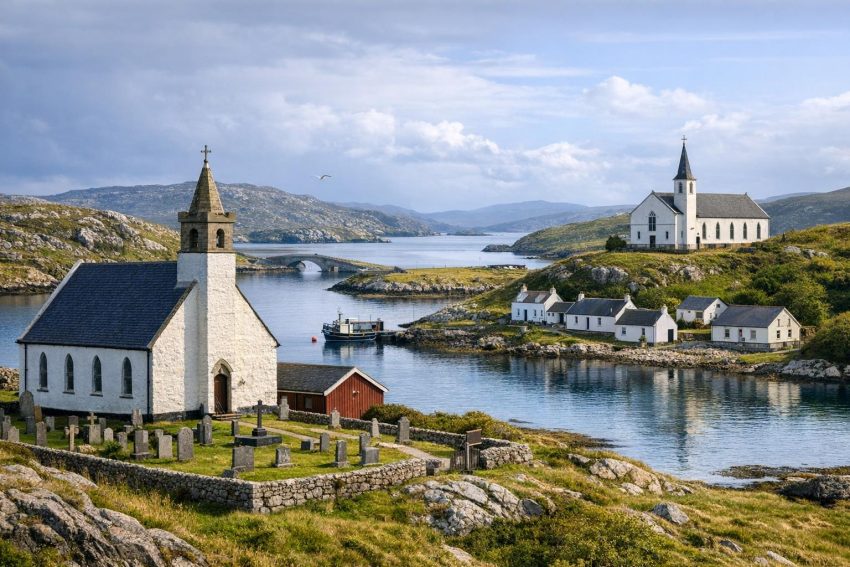
Scalpay is a small island off the east coast of Harris in the Outer Hebrides, lying in the sheltered waters near the Sound of Harris. Its Gaelic name, Sgalpaigh na Hearadh, distinguishes it from Scalpay near Skye. For much of its recorded history, the island has shared the language, economy and Presbyterian religious culture of Harris. Christianity influenced worship, education, family customs, attitudes to work and the weekly rhythm of island life.
Religious observance on Scalpay has never remained fixed. Denominational divisions, migration, declining church attendance, the spread of English and improved transport have all altered local practice. Even so, Presbyterian Christianity remains closely associated with the island’s historical identity. Churches, burial grounds, Gaelic psalmody and family memories still record a period when religious institutions occupied a central place in community affairs.
Scalpay’s geographical and religious setting
Scalpay belongs culturally and administratively to Harris, although water once made it a more separate community than a map might suggest. Before the Scalpay Bridge opened in 1997, residents relied on boats and a ferry connection. Bad weather, winter darkness and ferry timetables could affect travel to schools, shops, medical appointments and church services on Harris.
That separation encouraged island residents to maintain local worship arrangements. A small congregation might not have had its own resident minister, but it could still hold services led by a visiting minister, elder, missionary or authorised lay preacher. Prayer meetings, Sunday schools and Bible classes required less formal organisation and could continue between ministerial visits.
The bridge altered those arrangements. Residents gained easier access to congregations elsewhere in Harris, and ministers could reach Scalpay by road. This reduced the practical isolation that had supported separate island institutions. It also meant that a church building on Scalpay no longer had to provide every service required by local worshippers.
Scalpay’s religious history should therefore be read as part of the history of Harris rather than as a detached account. Ministers, elders and worshippers often moved between communities. Marriages and family relationships connected Scalpay with Tarbert, the Bays of Harris, Lewis and more distant Hebridean settlements. Denominational decisions made elsewhere could have direct consequences for a small island congregation.
Christianity in Harris before modern Presbyterianism
Christianity reached the Hebrides many centuries before the formation of the churches now associated with Harris. Early Christian communities in western Scotland were influenced by Gaelic monastic traditions and later by the medieval Roman Church. Parish organisation developed gradually, and surviving chapels, place names and burial sites across the Hebrides record this older religious presence.
Evidence relating directly to early Christianity on Scalpay is less complete than the material available for larger settlements. Small islands did not always produce detailed written records, and local worship could depend on clergy serving a broad area. Archaeological remains and oral traditions may also be difficult to date with confidence. Claims about an early chapel or sacred site therefore require careful comparison with documentary and archaeological evidence.
The Scottish Reformation of the sixteenth century replaced the authority of the Roman Church with a Protestant national church. The process did not occur at the same speed everywhere. Distance, difficult travel, Gaelic language and shortages of ministers slowed institutional reform in the Highlands and Islands. Older customs could survive beside Protestant teaching for generations.
By the eighteenth and nineteenth centuries, Presbyterian organisation had become firmly established in Harris. Ministers preached from the Bible, kirk sessions supervised congregational affairs, and elders acted as local representatives of church authority. This structure became the basis of the religious culture later remembered on Scalpay.
The Presbyterian tradition
Presbyterian churches are governed through councils of ministers and elders rather than bishops. At congregational level, the kirk session deals with pastoral care, membership and discipline. Presbyteries bring together churches across a wider district, while national assemblies decide matters affecting the denomination as a whole.
In a small island community, an elder’s role could reach well beyond meetings and paperwork. Elders visited homes, supported ill or bereaved residents, helped arrange communion seasons and represented local concerns to ministers. They often knew the congregation through kinship, fishing work and neighbourhood ties. That closeness could provide practical care, though it could also make church discipline feel highly personal.
Presbyterian worship traditionally gave a prominent place to preaching, prayer, Scripture reading and psalm singing. Church interiors tended to be plain, and visual decoration played a smaller role than it did in Catholic or Episcopal worship. The sermon was often long by current standards. Worshippers expected the minister to explain a biblical passage and apply it to personal conduct, family duties and communal responsibility.
Formal simplicity did not mean that worship lacked ceremony. Communion services, baptisms, marriages and funerals followed recognised patterns. Seating arrangements, the order of psalms, the role of elders and the use of Gaelic all carried social meaning. Regular worship also gave residents a shared timetable in a community where weather and fishing work could otherwise make daily life unpredictable.
The Church of Scotland and the Disruption of 1843
The Church of Scotland served as the established national church after the Reformation settlement. Its parish system was intended to provide worship and pastoral care throughout Scotland, including remote island districts. In practice, large parishes and difficult travel often placed heavy demands on Highland ministers.
During the nineteenth century, disputes developed over the right of congregations to choose ministers and over interference by landowners and civil courts in church affairs. These disputes led to the Disruption of 1843. Many ministers and members left the Church of Scotland to form the Free Church of Scotland.
The Free Church gained strong support throughout much of the Highlands and Islands. In Lewis and Harris, evangelical preaching, Gaelic religious culture and dissatisfaction with existing church arrangements helped it attract substantial congregations. Residents contributed money, labour and materials for new churches and manses, even where households had modest incomes.
Scalpay shared in the denominational loyalties found across Harris. Families might identify strongly with the Church of Scotland or the Free Church, and later divisions created further Presbyterian groupings. The Free Church union of 1900, the survival of a separate Free Church body and later disagreements all left their mark on Hebridean religion.
Denominational labels can be difficult to trace at local level. A building might change ownership, a congregation might join a neighbouring charge, or worshippers might attend different churches at different periods. Family memories sometimes preserve older names that no longer match formal church structures. Care is therefore needed before attaching a historic Scalpay meeting place to one denomination throughout its entire use.
Church buildings and meeting places on Scalpay
A church building on Scalpay served both religious and social purposes. Its main function was public worship, but it might also accommodate prayer meetings, Bible study, Sunday school, congregational discussions and funeral services. Before community halls became common, church premises were among the few indoor places capable of holding a sizeable gathering.
Maintaining such a building required continuing local effort. Members paid for heating, repairs, insurance and cleaning. Salt air, rain and strong winds could damage roofs, stonework, doors and windows. A small congregation could face a heavy financial burden when major repairs became necessary.
The availability of a minister also affected how often a building was used. Where one minister served several communities, services had to be arranged around travel and competing timetables. Scalpay residents might receive a morning or evening service on selected Sundays, with another congregation meeting at a different hour. Lay leadership helped fill gaps, especially for prayer meetings and informal gatherings.
Road access after 1997 made shared parish arrangements more practical. A minister based on Harris could cross the bridge without waiting for a ferry, and Scalpay residents could attend services in Tarbert or elsewhere. Easier movement was useful, though it also weakened the case for maintaining every older building as a fully separate place of worship.
Where church use declines, decisions about a building can be sensitive. Members may see it as a house of worship, while former residents may value it because baptisms, marriages and funerals took place there. Any sale, closure or change of use can therefore raise questions about memory, ownership and the future care of graves or memorials.
Ministers, elders and lay leadership
The minister traditionally carried responsibility for preaching, pastoral visiting, baptisms, weddings, funerals and preparation for communion. On Scalpay, those duties had to be balanced against distance and travel. A minister serving a wider Harris charge might spend much of the week moving between scattered settlements.
Pastoral visits were once a regular part of church work. Ministers and elders called at homes where someone was ill, recently bereaved or absent from worship. Such visits combined religious counsel with ordinary conversation. They also helped church leaders identify households needing food, fuel, transport or other practical assistance.
Lay people kept congregational life running between formal services. Elders opened meetings, read Scripture and led prayer. Sunday school teachers instructed children, precentors led psalm singing, and volunteers maintained the building. Women often carried much of the organisational work through fundraising, hospitality, cleaning and care for families, even where formal office remained largely male.
This dependence on volunteers remains relevant. Smaller congregations may have fewer people available to serve as elders, treasurers, musicians or safeguarding officers. Administrative requirements have also grown. The work once handled informally now includes building regulations, insurance, financial reporting and child protection procedures.
Sunday observance and the island week
The Sabbath was one of the clearest expressions of Hebridean Presbyterian culture. Sunday was set aside for worship, rest, Bible reading and family life. Non-essential labour, shopping and organised recreation were discouraged. Fishing boats generally remained in harbour, and households tried to complete routine work before Saturday night.
Sunday observance affected domestic life as well as public activity. Meals might be prepared in advance, children wore formal clothes for church, and visits centred on relatives or neighbours rather than entertainment. Some families attended more than one service, with Sunday school or an evening meeting added to the morning service.
Practical exceptions always existed. Livestock still required care, medical emergencies did not wait for Monday, and severe weather could force fishermen to protect boats and gear. Island residents generally recognised necessary work, though opinions differed over where necessity ended and avoidable activity began.
The strength of Sabbath practice varied between denominations, households and generations. Some families avoided almost all recreation, reading only religious material and refraining from travel. Others followed a less strict routine while still treating Sunday differently from the rest of the week. It would be misleading to present every Scalpay resident as following one identical code.
During the twentieth century, television, private cars, tourism and employment outside traditional industries changed the pattern. Ferry and transport debates elsewhere in the Hebrides also brought Sabbath observance into public discussion. On Scalpay, the bridge made Sunday travel easier and reduced the physical separation that had supported older habits.
Sunday remains quieter than an ordinary weekday for some residents, and church services continue to shape the day for worshippers. Yet the island now includes people with a broad range of views. Some maintain strict observance, some attend church without following older restrictions, and others treat Sunday mainly as a day off work.
Gaelic in preaching and prayer
Scottish Gaelic was historically the everyday language of many Scalpay households. It was used in conversation, storytelling, work and religious instruction. A minister who could preach in Gaelic had a clear advantage because worshippers could hear biblical teaching in the language they knew best.
Religious Gaelic developed a rich vocabulary through Bible translation, preaching and devotional writing. The translation of Scripture into Gaelic allowed households to read biblical texts at home, although literacy levels and access to books varied. Oral teaching remained valuable, particularly among people who spoke Gaelic fluently but had received schooling mainly in English.
Prayer meetings also supported Gaelic use. People who rarely spoke in formal public settings might pray or discuss a sermon in their first language. Repeated biblical phrases and familiar religious expressions passed between generations through speech as much as through print.
English became more common through schooling, government work, broadcasting and migration. Younger residents often gained stronger literacy in English, even where they understood Gaelic at home. As the number of fluent speakers declined, some congregations moved to English services or offered Gaelic worship less often.
The choice of language was not simply practical. For older worshippers, Gaelic could carry emotional and family associations that an English service did not reproduce. Younger people, however, might find an entirely Gaelic sermon hard to follow. Churches have sometimes responded through bilingual readings, alternating services or printed material in both languages.
Gaelic psalm singing
Gaelic psalm singing is among the most recognisable forms of Hebridean worship. It uses lined-out psalmody, in which a precentor sings a line and the congregation follows. Each singer adds slight melodic variation, producing a broad, flowing sound without instrumental accompaniment.
The practice arose partly because printed books were scarce and not every worshipper could read. Lining out allowed the full congregation to participate. It also suited worship in Gaelic, where the rhythm and pronunciation of the words shaped the melody.
Traditional Presbyterian congregations often sang metrical psalms rather than modern hymns. Instruments were absent from many services, reflecting a belief that congregational voices were sufficient for biblical worship. This gave the precentor an influential role. A capable precentor had to know the tune, set a workable pitch and maintain the pace without forcing every singer into exact uniformity.
Scalpay’s residents shared this musical tradition with Harris and Lewis. People heard psalmody at regular services, communion gatherings and funerals. The sound became associated with church buildings, family faith and Gaelic identity. Recordings have since brought Hebridean psalm singing to audiences far beyond the islands, though a recording cannot fully reproduce the social setting of congregational worship.
Fewer fluent Gaelic speakers and smaller congregations have placed pressure on the tradition. Psalmody depends on communal participation rather than a trained choir. If only a handful of worshippers know the words or melodies, continuation becomes harder. Teaching sessions, recordings and cultural projects can preserve the musical form, but its religious meaning comes from use in worship.
Communion seasons and religious meetings
In many Highland and Hebridean Presbyterian communities, communion was historically celebrated less often than it is in many churches now. The service could form part of a communion season lasting several days. Visiting ministers preached, worshippers attended preparatory meetings, and guests stayed with local families.
These gatherings combined solemn religious examination with considerable social activity. People travelled from neighbouring districts, renewed family connections and discussed sermons after services. Hosting visitors required food, beds and domestic work, placing much of the practical responsibility on local households.
Admission to the Lord’s Supper was once closely supervised. Prospective communicants could meet the minister and elders before taking part. In some Presbyterian traditions, approved communicants received a small token that admitted them to the communion table. The practice reflected a serious view of church membership and personal profession of faith.
Communion customs changed during the twentieth century. Services became shorter, travel became easier and formal admission practices softened in many congregations. Even where older arrangements no longer continue, memories of communion weekends remain part of family accounts of religious life in Harris and Scalpay.
Weekly prayer meetings offered a more regular form of participation. They required no communion season and could be held with fewer people. In periods without a resident minister, such meetings helped a congregation maintain continuity. They also allowed elders and other members to exercise leadership.
Baptism, marriage and family religion
Churches traditionally marked major stages in family life. Baptism welcomed children into the visible life of the congregation and placed duties on parents to provide Christian instruction. In Presbyterian practice, infant baptism usually took place during public worship rather than as a private ceremony detached from the congregation.
Marriage linked two people, but in a small island it could also connect extended family networks across Scalpay, Harris and Lewis. Ministers conducted ceremonies in churches, homes or other approved settings. Church teaching shaped expectations surrounding courtship, sexual conduct and household responsibilities, although lived practice did not always match formal standards.
Family worship once formed part of many homes. A parent or grandparent read from the Bible, led prayer and selected a psalm. The frequency differed between households. Some held worship every day, while others reserved it for Sunday or periods of illness and bereavement.
Children learned religious practice by repetition. They watched adults prepare for church, listened to Gaelic prayers and became familiar with biblical language before fully grasping its meaning. Grandparents could have a particularly strong role where parents were absent through fishing, merchant shipping or employment away from the island.
Patterns have broadened. Couples may choose civil marriage, baptism is less common among non-attending families, and households differ in their religious views. Yet a family with little weekly contact with church may still request a minister for a wedding, funeral or memorial service because of long association with the congregation.
Funerals, burial and communal support
Funerals have carried considerable weight in Scalpay’s communal life. News of a death travels quickly in a small population, and neighbours commonly offer food, transport, practical work and company. Relatives living elsewhere may return to the island, making a funeral both a religious service and a family reunion under difficult circumstances.
Traditional Presbyterian funerals placed emphasis on Scripture, prayer and the hope of resurrection. Gaelic psalms could be sung, especially where the deceased and family had close ties to Gaelic worship. The tone was generally restrained, with little interest in elaborate ceremony.
Ministers and elders visited the bereaved before and after the funeral. Their role included arranging the service, discussing readings and offering pastoral support. Neighbours might prepare the grave, manage vehicles, receive visitors and provide meals. Such work showed how church life and mutual aid overlapped.
Burial grounds provide valuable historical evidence. Gravestones record family names, dates, occupations and links with other places. Inscriptions may appear in English or Gaelic, and repeated surnames reveal long-established kinship groups. War service, deaths at sea and migration can also appear in memorial wording.
Funeral practice has become more varied. Some families choose cremation, a civil celebrant or a service with fewer traditional forms. Geography still affects choices because crematoria and specialist services are not close to Scalpay. Even where a funeral is non-religious, neighbours may follow older customs of visiting and practical support.
Religion, fishing and maritime life
Scalpay’s economy was long associated with fishing and other maritime work. The sea provided income but also exposed families to danger, uncertain weather and periods of absence. Religious belief offered a language for discussing risk, providence, loss and gratitude.
Fishermen might pray before leaving harbour, and families at home remained alert to changing weather. A boat overdue from fishing affected the whole settlement because crews were often related to many households. Ministers and elders supported families during searches, accidents and deaths at sea.
Sabbath teaching also affected fishing schedules. Boats generally avoided routine work on Sunday, though a vessel at sea had to respond to weather and safety. Disagreements could arise where market demands or fishing conditions encouraged activity that older residents regarded as unnecessary Sabbath labour.
Fishing migration connected Scalpay people with ports elsewhere in Scotland and Britain. Seasonal workers encountered other church traditions and less restrictive social customs. Some attended Gaelic services arranged for migrant fishing communities, allowing familiar worship to continue away from home.
Merchant shipping and naval service produced similar connections. Men returning from long periods away brought new ideas, habits and religious experiences. The island’s church culture was strong, but it was never sealed off from outside contact.
Religious education and the school
Children received Christian instruction from home, church and school. Parents taught prayers and Bible stories, Sunday school teachers provided organised lessons, and school education included religious material within the framework used across Scotland.
Sunday school usually offered short lessons, recitation, singing and preparation for congregational events. In a small community, teachers were often relatives or neighbours whom children met throughout the week. Religious authority therefore came from familiar adults rather than distant clergy alone.
Bible knowledge once carried social value beyond church membership. Biblical phrases appeared in ordinary speech, and sermons assumed that listeners knew major stories and characters. Children who attended regularly became familiar with the Psalms, the Gospels and the Ten Commandments.
Schooling also contributed to the movement from Gaelic to English. Earlier educational policy often gave English priority, even where pupils spoke Gaelic at home. This affected religious practice because younger speakers became more comfortable reading Scripture in English. Later support for Gaelic-medium education has helped the language, though church use depends on fluent adult speakers as well as school provision.
Sunday schools now face demographic and practical pressures. There may be too few children to divide into age groups, and families often travel for sports or other activities. Congregations may combine classes, hold occasional children’s events or work with churches elsewhere in Harris.
Church discipline and social expectations
Presbyterian churches historically exercised discipline through the kirk session. Matters could include drunkenness, sexual conduct, marital disputes, Sabbath breaking and prolonged absence from worship. The purpose was formally described as correction and restoration, though those called before a session could experience the process as public shame.
In a small island, privacy was hard to maintain. Elders knew local families, and news travelled rapidly. Church standards could therefore reinforce community opinion, while community opinion also influenced which behaviour drew attention.
Alcohol, card playing, dancing and public entertainment often prompted disagreement. Strict church members regarded some activities as spiritually harmful or likely to lead to disorder. Other residents saw them as ordinary recreation. The boundary differed by household and period, so simple claims that Scalpay either accepted or rejected such practices are not reliable.
Religious authority also interacted with gender and age. Older men held most formal offices, while women carried much of the unpaid work that sustained congregations and households. Young people could feel pressure to follow standards set by parents and elders. Migration for education or employment gave them contact with different attitudes and sometimes reduced church participation on their return.
Formal discipline has weakened in many Presbyterian congregations. Pastoral discussion now tends to replace public rebuke, and churches operate within a society that places greater weight on private choice. Older expectations may still influence family conversations even when kirk sessions no longer enforce them.
Women’s work in church and community
Accounts centred on ministers and elders can obscure the work performed by women. Women organised meals, raised funds, taught children, visited ill neighbours and prepared church buildings for services. Their contribution was often treated as ordinary duty rather than recorded leadership.
Communion gatherings and funerals depended heavily on domestic labour. Visitors needed accommodation and food, clothing had to be prepared, and bereaved households required support. Such work allowed public religious events to proceed smoothly.
Women’s groups also connected worship with charitable activity. They collected money for missions, relief work and church repairs. Meetings gave women a place to exchange news and organise help for households facing illness or financial strain.
Denominational rules concerning women in formal ministry have differed and have changed over time. The Church of Scotland ordains women as elders and ministers, while some Presbyterian bodies maintain male-only office. These differences affect who can preach, serve on sessions and represent a congregation in church courts.
Migration and religious identity
Scalpay has long been connected to communities beyond the island through work, marriage and migration. Residents moved to mainland Scotland, England, Canada and other destinations, while retaining family ties to Harris. Church membership could help migrants find familiar company in an unfamiliar town.
Gaelic congregations in urban areas offered worship similar to that known at home. Returning visitors brought news of those churches, and ministers sometimes had personal links with island families. Religious networks could assist newcomers with accommodation, employment contacts and social introductions.
Migration also reduced the resident population and removed many younger adults who might otherwise have become elders, teachers or volunteers. A congregation could retain a broad circle of supporters while having few people present each Sunday. Holiday visits and family funerals might temporarily fill a building that was quiet for much of the year.
Some former residents retain a cultural Presbyterian identity without attending church where they live. They may still value Gaelic psalms, family Bibles and burial on Scalpay. This attachment shows that religious identity can continue through memory and kinship after regular observance has ended.
The effect of the Scalpay Bridge
The opening of the bridge in 1997 changed access between Scalpay and Harris. Church attendance no longer depended on a ferry timetable, and ministers could visit more easily. Residents gained a wider choice of services, including Gaelic or English worship at different times.
This convenience had mixed consequences for local institutions. Better access supported shared ministry and reduced isolation, but it also made a separate Scalpay congregation harder to justify where attendance was low. People could drive to a larger church with more regular services, children’s activities and a resident minister.
The bridge also changed Sunday movement. Visiting relatives, attending services elsewhere and travelling for work became simpler. Older ideas about island separation gradually lost some practical force, even where residents retained a strong Scalpay identity.
Road access did not remove every problem. Winter weather, ageing residents and lack of private transport can still affect attendance. A service a short drive away may remain difficult for someone who no longer drives. Informal lifts and pastoral visits therefore continue to matter.
Religious variety and non-religious life
Presbyterian Christianity has been the main tradition on Scalpay, but it has never accounted for every resident’s beliefs. Movement into the island has brought Roman Catholics, members of other Protestant churches and people with no religious affiliation.
Roman Catholic communities have stronger historical roots in parts of the southern Outer Hebrides than in Harris. A Catholic living on Scalpay may need to travel for Mass or rely on visiting clergy. Members of smaller Protestant denominations face a similar issue if no local congregation follows their tradition.
Denominational identity does not always indicate personal belief. One resident may attend regularly and accept church teaching, while another may use the same denominational label mainly because of family history. A third may value church architecture and psalm singing without professing Christian faith.
Community life now includes secular associations, local development bodies, social groups and cultural events. Churches no longer provide the sole organised structure for public activity. They do, however, retain experience in visiting, fundraising, funeral support and care for older residents.
Church attendance and present-day pressures
Scalpay reflects the wider Scottish decline in regular church attendance. An ageing population, outward migration and reduced denominational loyalty have left many congregations with fewer members. The shortage of ministers creates further pressure, especially in rural and island parishes.
Churches respond by grouping congregations, sharing ministers and adjusting service times. Recorded sermons, online services and telephone access can support housebound members. Such methods are useful during poor weather or illness, though they do not replace the social contact of meeting in person.
Building costs remain a persistent concern. Heating a church for a small congregation can be expensive, and repairs may exceed local income. Denominations may review whether several buildings can remain open within a short driving distance.
Closure does not necessarily end worship. A congregation may meet in a hall, share a building with another church or travel to Harris. Yet the loss of a church building changes the visible character of the settlement and removes a place associated with generations of family events.
Religious records and family history
Church records can help trace Scalpay families. Registers may contain baptisms, marriages, burials, membership details and minutes of kirk session meetings. The surviving material varies by denomination and period, and some documents may be held in church, regional or national archives.
Census returns, civil registration and gravestone inscriptions can be compared with church records. Differences in spelling are common, particularly where Gaelic names were written by English-speaking officials. A person may also appear under a Gaelic form of a name in one source and an English form in another.
Kirk session minutes sometimes reveal more than dates. They may mention poverty relief, disputes, irregular attendance or applications for baptism. Such entries need careful treatment because they reflect the concerns and judgements of church officers rather than a neutral account of private life.
Oral history fills gaps left by written documents. Older residents may remember precentors, Sunday school teachers, communion visitors and former church buildings. Memory can blur dates, but repeated family accounts often preserve details absent from official records.
Preserving Scalpay’s religious heritage
Scalpay’s religious heritage survives through buildings, graveyards, documents, Gaelic speech, psalm tunes and family stories. Preservation should include both physical sites and recorded memory. A repaired building says little on its own if the people who used it are not documented.
Oral-history recordings can preserve accounts of ferry travel to services, Sabbath customs, communion weekends and funeral practice. Recordings of Gaelic prayer and psalmody are valuable because pronunciation, rhythm and local melody cannot be captured fully in written transcription.
Burial grounds require regular care, accurate mapping and respectful handling of damaged stones. Digital photography can preserve inscriptions that weather may erase. Family researchers can also help identify stones whose lettering has become difficult to read.
Church records need suitable storage, clear cataloguing and attention to privacy where recent personal details are involved. Older minute books and registers can be fragile. Copies may make the material easier to consult while protecting the originals from repeated handling.
Future use of former religious buildings may involve community meetings, cultural events or heritage displays. Such use can keep a building active, though alterations should respect memorials and the concerns of families connected with it. Practical reuse often offers a better prospect than leaving an empty structure to deteriorate.
Continuity and change on Scalpay
Religion on Scalpay is best described through continuity and change rather than a simple account of decline. Presbyterian churches once shaped the weekly calendar, public conduct, education and family ceremony to a degree that is no longer common. Gaelic preaching and lined-out psalmody connected worshippers with a wider Hebridean religious culture.
Those traditions remain visible even among residents who do not attend church. Sunday habits, funeral customs, biblical expressions and respect for former church leaders can survive after formal belief weakens. Family identity may still include a denominational connection established several generations ago.
At the same time, Scalpay is no longer religiously uniform. Residents vary in belief, language, church attendance and views on Sabbath practice. The bridge has widened access to congregations on Harris, while migration and modern communication have reduced the social authority once held by local churches.
The future may involve smaller congregations, shared ministers and fewer buildings in regular use. Gaelic worship may continue through occasional services and psalm-singing events rather than through every weekly meeting. Churches that remain active will probably depend heavily on volunteers and cooperation across Harris.
Scalpay’s religious history remains central to any account of the island. Christianity influenced how residents marked time, responded to death, educated children, supported neighbours and interpreted life at sea. The forms have changed, but churches, religious language and communal memory still show how closely faith was woven into the life of the island.