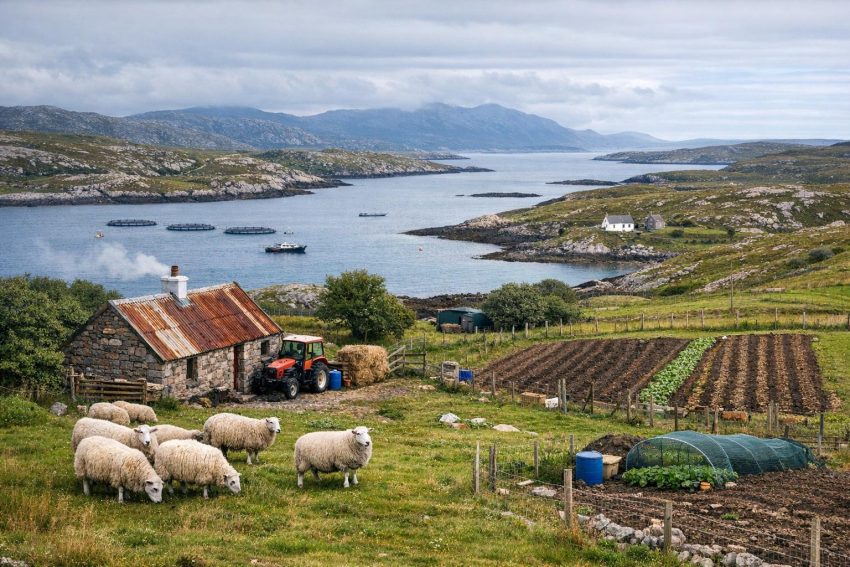
The Isle of Scalpay, known in Gaelic as Sgalpaigh, lies off the east coast of Harris in the Outer Hebrides. The narrow waters of North Harbour separate it from Harris, and a road bridge has connected the two islands since 1997. Rocky hills, peat-covered ground, small lochs, sheltered inlets and an indented coastline shape how residents have used the land.
Crofting has long formed part of life on Scalpay, though agriculture has rarely supported a household on its own. The island has little fertile ground, regular Atlantic weather and few large areas suitable for cultivation. Residents therefore developed a mixed household economy based on crofting, fishing, peat cutting, shore gathering, building work, public employment and jobs elsewhere in Harris.
This mixture was practical rather than unusual. A family might keep sheep, plant potatoes, cut fuel and earn wages from fishing or construction. The relative value of each activity changed from year to year. Weather, livestock prices, fishing seasons, family labour and access to transport all played a part.
Crofting on Scalpay should therefore be viewed as both a legal system of landholding and a working relationship between residents and the island. It affects settlement, housing, grazing, boundaries, roads and access to common land. Even crofts with little commercial production remain connected to wider questions about population, land use and the future of the community.
What crofting means on Scalpay
Crofting is a regulated form of small-scale landholding found mainly in the Highlands and Islands of Scotland. A croft may be held by an owner-occupier or by a tenant who rents it from a landlord. The crofter usually has an individual holding and may also possess grazing rights over shared land.
A croft is not defined only by its acreage or agricultural output. Crofting law places duties on crofters relating to residence, use and care of the holding. The details depend on tenure and circumstances, but the broad intention is to prevent croft land from being neglected or treated simply as an unused property asset.
On Scalpay, a croft may include grass near a house, rougher land farther away, small cultivated plots and a share in common grazing. Some holdings consist of several separated parcels. This division can reflect past allocation, family succession, topography or the gradual development of settlement.
Many Scalpay crofters earn most of their income outside agriculture. They may keep a flock, maintain fencing and produce fodder around other employment. That does not make the holding irrelevant. Part-time work is normal across many crofting areas because small, exposed holdings seldom generate enough income to cover all household costs.
The term crofter can therefore refer to someone with a handful of animals as readily as someone operating a larger agricultural business. Legal status, active use and community participation may matter as much as the volume of produce sold.
Crofts and conventional farms
Crofts differ from conventional farms in scale, tenure and organisation. A mainland farm may comprise a large block of enclosed fields run as one business. A Scalpay croft is more likely to contain small areas near housing, rough ground and rights shared with neighbouring crofters.
Common grazings are central to this distinction. They allow several holders to use an area that would be difficult to divide into practical individual units. Shared access can spread the value of rough pasture across the township, though it also requires agreed rules and regular cooperation.
Crofting also has a settlement function. It gives households a legal and practical connection to land beside or near their homes. This connection has helped sustain dispersed communities in places where conventional commercial agriculture would support few farms and fewer residents.
How Scalpay’s ground affects agriculture
Scalpay is hilly, rocky and heavily influenced by maritime weather. Much of its interior contains peat, heath, wet ground and exposed slopes. The island has pockets of better soil around settled areas, but broad stretches of level, fertile farmland are absent.
Strong winds can damage crops, dry out exposed vegetation and make routine work awkward. Rain keeps the ground wet and may delay mowing, peat cutting or construction. Salt carried inland by storms can affect grass and garden plants near the shore. Winters are relatively mild by latitude, but wetness and wind chill create demanding conditions for livestock.
Thin and acidic soils restrict crop choice. Cultivation usually works best on ground that has received manure, seaweed, lime or imported soil improvers over many years. Such treatment can create a useful plot, but it does not remove the labour required to maintain fertility and drainage.
Small gardens and croft plots have traditionally produced potatoes, turnips and other vegetables suited to cool conditions. Oats and fodder crops may be possible in favourable sites, although exposure and wet ground make results variable. Modern crofters are more likely to buy part of their winter feed than rely entirely on crops grown on the island.
Rough grazing
Most of Scalpay’s agricultural value lies in grazing. Sheep can use coarse grasses, heath and upland ground that cannot be cultivated economically. Hardy cattle may also graze croft land where grass quality, drainage and access are adequate.
Rough grazing still needs active care. Stocking levels must match the available forage, and animals require checking throughout the year. Gates, fences and handling pens need repairs. Wet hollows, exposed ridges and roadside areas can create additional risks, particularly during poor weather.
Grazing pressure also affects vegetation. Too many animals may wear paths into peat, reduce plant cover and encourage erosion. Too few may allow rank grass or scrub to spread. The appropriate stocking rate varies between parcels, seasons and years, so fixed assumptions rarely work well.
Improved ground near settlements
Ground beside houses often shows the accumulated work of earlier generations. Stones were removed, drains opened and organic material added. Seaweed brought from the shore supplied nutrients and helped improve soil structure. Livestock manure served the same purpose and returned fertility to plots used for potatoes or fodder.
These areas may appear modest, yet they represent a considerable investment of labour. A small green field amid surrounding heath is rarely an accident. It often records repeated cultivation, manuring and drainage over many decades.
Modern use may differ from the original purpose. A former potato plot might now provide grazing, hay or space around a house. Even so, the altered soil and old boundaries continue to show how closely domestic life and agriculture were once connected.
Settlement and the layout of croft land
Most settlement on Scalpay follows the coast, sheltered bays and the island’s road network. Houses, sheds, small enclosures and tracks fit around rocky ground rather than following a regular grid. The result is a dispersed pattern shaped by terrain and access to both land and sea.
A croft does not always form one neat block behind a house. It may contain strips or parcels separated by other holdings, roads or uncultivated ground. A crofter might use one section for grazing, another for fodder and a third for housing or storage.
Fragmentation reflects earlier methods of sharing scarce productive land. Giving households access to different qualities of ground could distribute agricultural opportunities more fairly. The trade-off was extra travel, awkward fencing and more work when moving animals or machinery.
Boundaries may be marked by wire fences, stone dykes, burns, roads or older features that are not immediately obvious to a visitor. Legal croft boundaries do not always match what appears to be a field boundary on the ground. Anyone buying, assigning or developing croft land therefore needs accurate records and suitable professional advice.
Buildings associated with crofting
Earlier island houses relied heavily on local stone, turf and thatch. Later buildings adopted slate, corrugated metal, blockwork and other imported materials. Agricultural structures changed at the same time. Traditional byres and barns gave way to metal sheds, feed stores, handling areas and machinery shelters.
Old stone structures may now be roofless, incorporated into newer buildings or used for storage. Their position can reveal former settlement patterns and the close relationship between housing and livestock. Animals were once kept much nearer domestic buildings than current practice commonly permits.
Modern sheds must withstand wind loading, driving rain and salt exposure. Materials that perform well in inland districts may corrode quickly on Scalpay. Maintenance is therefore a routine expense rather than an occasional job. A loose roof sheet during a winter gale has a habit of becoming everyone’s problem.
Historical development of crofting
Scalpay’s crofting history forms part of the landholding history of Harris and the wider Outer Hebrides. Before statutory crofting rights existed, access to land depended on estate arrangements, customary practice and local relationships. Tenants and subtenants had fewer protections than later crofters received under law.
During the eighteenth and nineteenth centuries, Highland estates altered rents, settlement patterns and agricultural use. Population growth put added pressure on productive ground. Across the Highlands and Islands, estate policies varied, but many communities experienced displacement, reorganisation or movement onto poorer coastal land.
Scalpay’s dependence on fishing affected its development. Access to sheltered water and the Minch gave residents an income source beyond the soil. Estate owners could regard fishing settlements as economically useful even where the agricultural ground was weak. That relationship helped produce communities in which crofting and maritime work were closely linked.
Households still faced insecurity. Poor harvests, low fish catches, illness or changes in rent could expose families to hardship. Seasonal migration and wage labour helped spread risk, though such work often took adults away during busy periods on the croft.
The Crofters’ Holdings (Scotland) Act 1886
The Crofters’ Holdings (Scotland) Act 1886 changed the legal position of many crofting tenants. It introduced greater security of tenure, a system for setting fair rents and rights to compensation for qualifying improvements. These reforms followed years of protest and political pressure across Highland communities.
The Act did not settle every dispute or provide all households with sufficient land. It did, however, recognise that crofters had interests deserving legal protection. A tenant who invested labour in buildings, drainage or soil improvement gained a firmer basis for remaining on the holding.
Later Acts revised and expanded crofting regulation. Responsibilities now associated with the Crofting Commission include oversight of assignation, succession, subletting, division, letting and decrofting. Planning permission and crofting approval are separate matters, so receiving one does not automatically provide the other.
Owner-occupiers and tenants
Some crofts remain tenanted, while others are owned by the person occupying them. Owner-occupation does not remove the land from crofting regulation. An owner-occupier crofter still has duties relating to residence, use and maintenance.
Tenanted and owner-occupied crofts may look identical from the road, yet their legal arrangements differ. A tenant deals with a landlord as well as the Crofting Commission in relevant cases. An owner-occupier holds the title but remains subject to crofting law.
This distinction matters during sales, inheritance and development. Ordinary property assumptions can be misleading if a house, garden or access route remains part of a registered croft. Prospective purchasers generally need a solicitor familiar with crofting law rather than one treating the transaction as a standard rural house sale.
Common grazings and shared responsibility
Common grazings allow a group of crofters to share grazing land according to recognised rights. Each shareholder may possess a souming, meaning an entitlement based on an approved number and type of livestock. The stated entitlement does not necessarily mean that every shareholder uses the full allowance each year.
On Scalpay, shared grazing makes practical use of rough land that would be awkward to divide. It can provide seasonal forage and space for animals away from cultivated plots. Yet common use requires administration. Someone must arrange maintenance, discuss stocking, manage gates and respond when fencing fails.
A common grazings committee may be appointed to oversee the land. Its work can include preparing regulations, collecting payments, arranging repairs and dealing with agencies or contractors. The committee also provides a formal route for discussing proposals that affect shareholders.
Participation varies. Some shareholders keep livestock regularly, some use only part of their rights, and others may not graze animals at all. Low participation can place more work on active crofters because shared infrastructure still needs attention even when animal numbers fall.
Soumings and livestock numbers
A souming sets out the livestock capacity assigned to each grazing share, often expressed through sheep and cattle numbers. It helps prevent unrestricted stocking on communal land. The actual ecological carrying capacity may change with vegetation, weather and land condition, so historical allowances require sensible application.
Overstocking can damage peat and reduce forage quality. Understocking presents a different set of issues, including coarse vegetation and reduced agricultural use. Committees and active graziers must balance legal rights with the practical condition of the ground.
Shared improvements
Common works can include fencing, gates, water points, culverts, tracks and gathering pens. These projects may require grant support because the cost can exceed the direct agricultural return. Contributions must also be allocated fairly among those who benefit.
Shared machinery or contractor hire can reduce costs. A tractor, topper or handling system may be difficult for one small croft to justify, but cooperative use makes the figures less discouraging. Clear arrangements over fuel, repairs, storage and timing help prevent disputes.
Sheep, cattle and seasonal work
Sheep suit much of Scalpay’s rough ground. They can graze areas inaccessible to larger machinery and tolerate exposed conditions when managed properly. Common breeds and crosses are chosen for hardiness, maternal ability, meat production and the type of ground available.
The crofting year often centres on lambing, marking, veterinary treatment, gathering, shearing and sales. Timing varies with weather and flock management. Lambing outdoors reduces building requirements but increases exposure to wind, rain and predation. Regular checks become necessary, especially during poor conditions.
Gathering sheep from rough ground can require several people. Animals do not always respect administrative boundaries, and they are remarkably good at choosing the least convenient route. Neighbouring crofters may help one another, continuing a practical form of cooperation that predates modern equipment.
Shearing produces wool, though wool income often covers only a small part of the cost. Sheep still need shearing for welfare. Transport to sales or slaughter also adds expense, particularly from island locations where distance and ferry travel affect agricultural supply chains.
Cattle on small crofts
Cattle require better forage, stronger handling facilities and more winter feed than sheep. They can still play a useful role where crofters have improved grass and suitable buildings. Hardy breeds and crosses are commonly preferred because they cope better with exposed weather and rough grazing.
Keeping only a few cattle does not remove the need for safe pens, loading access, veterinary care and winter storage. Fixed costs can be high per animal. Crofters may therefore share a bull, use artificial insemination, hire handling gear or cooperate during transport.
Cattle can help manage coarse grass and create variation in sward height. Their weight may damage wet peat or soft fields, however, so seasonal movement and stocking density need care.
Winter fodder and storage
Winter feeding is one of the main constraints on island livestock. Grass growth slows, exposed pasture loses condition and wet ground becomes prone to poaching. Hay, silage or purchased feed must bridge the gap.
Producing fodder requires a suitable weather window. Mowing and baling can become a tense exercise when rain is forecast, although island crofters are well accustomed to reading forecasts with healthy suspicion. Contractors may cover several holdings during the same short dry spell, making timing difficult.
Feed must be stored away from rain and salt-laden wind. Bales left outdoors need sound wrapping and a firm base. Damaged plastic can spoil silage and create waste, while loose wrapping may present a hazard to livestock and wildlife.
Potatoes, gardens and soil improvement
Potatoes were once a central food crop in Hebridean households. They offered a high yield from a small plot and tolerated cool conditions better than many cereals. Ground preparation remained demanding because stones had to be removed and fertility maintained.
Families applied manure, seaweed and other organic material to cultivated strips. Seaweed supplied potassium and trace nutrients, though fresh material could contain salt and needed sensible handling. Collection also depended on shore access, tides and local rights.
Turnips, cabbage and other hardy vegetables supplemented potatoes. Cultivation close to the house made it easier to protect crops and return household or animal manure to the soil. Walls and fences kept livestock out, at least in theory.
Home food production has declined as shops, road transport and refrigeration have improved. Some residents still maintain gardens, polytunnels or small potato plots. Protected growing can extend the season and reduce wind damage, but structures must be firmly anchored. Scalpay weather has little respect for a budget greenhouse.
Peat cutting and domestic fuel
Peat provided domestic fuel across the Outer Hebrides for generations. Crofters often held rights to cut peat from allocated banks on common ground. The work formed part of the annual household calendar rather than a separate commercial industry.
Cutting usually began when conditions allowed the peat to dry through late spring and summer. Blocks were cut, laid out, turned and later stacked. Several dry periods might be needed before the fuel could be carried home and stored.
The process demanded labour and close attention to weather. Poor drying conditions produced heavy, wet fuel that was difficult to transport and burn. Mechanical equipment later reduced some manual work, though vehicles can damage soft ground if used carelessly.
Domestic peat use has declined due to electricity, oil heating and changes in household routines. Peatland conservation and carbon storage now receive greater attention as well. Where cutting continues, scale, location, drainage and the condition of the bog all affect its impact.
Fishing within the crofting household
Fishing has often contributed more cash income than agriculture on Scalpay. Inshore waters provided fish and shellfish, and islanders also worked in larger fisheries beyond local waters. Boat ownership, crewing and shore work linked many households to the sea.
A mixed household might keep animals and grow food while one or more adults worked aboard a vessel. Other family members handled livestock during absences. Labour was divided according to age, skill, season and opportunity rather than through a strict separation between farming and fishing.
Fishing income could pay rent, purchase feed or fund improvements to buildings. Croft produce reduced household expenditure and supplied food. Peat reduced fuel costs. None of these activities had to stand alone to be useful.
The balance has changed with fishing regulation, vessel costs, market conditions and employment patterns. Construction, education, health care, transport, retail and public services now support many island households. Crofting often continues beside paid work rather than replacing it.
The effect of the Scalpay bridge
Before the bridge opened in 1997, regular movement between Scalpay and Harris depended on boats and ferry arrangements. Weather and timetables affected access to employment, services and agricultural supplies. Moving livestock, feed or machinery involved added planning.
The bridge gave residents direct road access to Harris and onward ferry connections. Crofters could reach suppliers, contractors, veterinary services and markets more easily. Residents also gained a wider choice of jobs while remaining based on Scalpay.
Better access did not make island agriculture cheap. Distances to major markets remain considerable, and freight costs still affect feed, fencing and building materials. The bridge did, however, reduce one layer of logistical difficulty.
Road access has also increased pressure for housing and non-agricultural development. Land beside roads and services may be attractive for building, yet it may remain under crofting tenure. This brings crofting regulation, planning policy and community housing needs into the same discussion.
Crofting law, duties and land transactions
Crofting is regulated rather than governed only by private agreement. A crofter may need consent or formal approval for actions such as assignation, division, subletting or decrofting. The applicable process depends on whether the croft is tenanted or owner-occupied and on the proposed change.
Crofters generally have duties to live on or near the croft, avoid misuse and keep the land in purposeful use. Agricultural production is one route, but other approved uses may also meet legal requirements. Circumstances are assessed through the statutory framework rather than by appearance alone.
Assignation transfers a tenancy to another person, subject to the required procedure. Subletting allows another person to use a tenanted croft for an agreed period. Division separates a holding into more than one croft. Each action can affect viability, access and future management.
Decrofting
Decrofting removes land from crofting tenure through a formal process. It is commonly considered for a house site, garden, access or another development. Planning permission does not itself decroft land, and decrofting does not itself grant planning permission.
The distinction protects the crofting status of land and allows agricultural and community interests to be considered. Applicants may need plans showing boundaries, access and the area proposed for removal. Poorly defined applications can cause delays, particularly where title boundaries and occupied areas differ.
Removing a large or productive area may weaken the remaining croft. Access routes can also divide grazing parcels or make machinery movement harder. Careful site selection can reduce such effects.
Succession
Succession can keep a croft within a family, but legal procedure still matters. A successor may inherit an owner-occupied croft or seek transfer of a tenancy, depending on the arrangement. Wills, family agreements and crofting records should be kept current.
Informal assumptions create problems after a death. Several relatives may believe they hold rights, or an intended successor may live away and have no plan for the land. Early legal advice can prevent a croft from remaining unresolved for years.
Costs and the economics of a small holding
Crofting income must be considered against fencing, feed, veterinary care, transport, machinery and building repairs. A small flock may produce sale income, but fixed costs remain high. The arithmetic can be rather stern.
| Cost area | Typical requirement | Island consideration |
|---|---|---|
| Fencing | Posts, wire, gates and labour | Wind, salt and rocky ground increase wear |
| Winter feed | Hay, silage or concentrates | Freight and storage add cost |
| Livestock care | Medicines, tagging and veterinary work | Travel and appointment timing may matter |
| Machinery | Mowing, topping, baling and transport | Sharing or contractor hire is often practical |
| Buildings | Shelter, feed storage and handling areas | Structures need strong weather resistance |
Many crofters reduce expenditure through shared labour and machinery. Used equipment may be economical if parts and repair skills are available. A cheap machine that cannot be repaired locally soon stops being cheap.
Public grants may support agricultural buildings, fencing, drainage, livestock handling or new entrants, depending on current schemes and eligibility. Applications commonly require quotations, business details and approval before work begins. Funding rules change, so crofters need current guidance before committing money.
Direct profit is not the only measure of value. A croft can provide food, grazing, housing connections, family continuity and control over nearby ground. Those benefits are real, though they do not pay every invoice.
Peatland, grazing and habitat care
Scalpay’s croft ground includes wet heath, blanket peat, grassland, freshwater lochs and coastal habitats. These areas support plants, insects and birds adapted to exposed island conditions. Agricultural use can help keep some ground open, but poor practice can damage soils and water.
Peat stores carbon when it remains wet and covered by healthy vegetation. Drains, repeated vehicle use, fire or concentrated trampling may expose peat to erosion. Once bare channels form, water can remove material and widen damaged areas.
Stock management can reduce pressure on vulnerable ground. Crofters may alter seasonal access, move feeding sites or avoid wet sections during winter. Fencing can control movement, though it adds cost and may affect wildlife or public access.
Restoration work can include blocking old drains, stabilising eroded peat and changing grazing patterns. Such projects need consultation with crofters and grazing shareholders because interventions affect practical land use. Local knowledge can identify old routes, wet hollows and areas where livestock naturally gather.
Balancing habitat and agricultural use
Environmental goals and crofting do not always point in opposite directions. Moderate grazing can maintain open grass and heath used by certain birds and plants. Active crofters also notice blocked drains, damaged fences, erosion and animal health issues during routine work.
Conflict can arise over stocking rates, seasonal restrictions or new fencing. Reducing animals may aid one habitat but reduce the agricultural reason for maintaining infrastructure. Sound decisions require site-based evidence and discussion with those who work the ground.
Gaelic place names and local knowledge
Gaelic remains closely associated with Scalpay and Harris. Place names describe bays, hills, lochs, points, channels and areas of grazing. They may record physical features, ownership, past events or traditional uses.
This naming system had practical value. Residents needed to describe where sheep had been seen, where peat could be cut and which route was safe in poor weather. Fine distinctions between nearby areas mattered to people working without modern mapping or mobile communication.
Knowledge passed through families also covered lambing sites, shelter, soil quality, tides and seasonal water movement. Some of it is difficult to record in formal maps. A wet patch that looks harmless in summer may be avoided by anyone who has watched a tractor sink there in February.
As fewer people work the land regularly, place-based knowledge can fade. Recording Gaelic names, oral histories and land practices helps retain an accurate account of how Scalpay has been used. Continued crofting also keeps that knowledge practical rather than purely archival.
Tourism, access and working land
Visitors encounter grazing animals, small fields, stone walls, tracks and open moor across Scalpay. These features are partly the result of crofting. They are not decorative installations, and the ground may contain livestock, machinery or ongoing work.
Scotland’s outdoor access rights permit responsible recreation across much of the countryside. Responsibility matters on croft land. Dogs should remain under close control around sheep and cattle, especially during lambing. Gates should be left as found, and parked vehicles must not block tracks or field entrances.
Walking through a flock can cause stress or separate lambs from ewes. A dog that appears calm may still trigger livestock movement. Visitors should give animals room and alter their route where needed.
Tourism can add income through accommodation, food, guiding and locally made goods. A croft house or outbuilding may support visitor use if planning and crofting requirements are met. Such income can help maintain land and buildings, though holiday use must be balanced against permanent housing needs.
Housing and population
Crofting communities need residents who can live near the land they manage. Housing costs, construction expenses and available sites all affect whether younger households can remain on Scalpay. A croft without practical access to housing may be difficult to operate.
Building on croft land requires attention to planning, access, drainage, title and crofting status. Rocky ground raises construction costs, and exposed sites demand suitable design. Roads and utility connections may add more expense than the house plot itself suggests.
New housing can support population and help families take on crofts. Poorly placed development can fragment holdings, obstruct access or remove productive ground. Site choice should account for current agricultural use and foreseeable succession.
Second homes and short-term accommodation may bring spending and property investment, but they can also reduce the stock available for permanent residents. The issue is not confined to crofting, yet it directly affects who is present to use croft land and serve on local committees.
Prospects for crofting on Scalpay
Crofting on Scalpay is likely to remain a part-time activity for many households. Paid employment provides regular income, and croft work continues around shifts, family commitments and weather. This model is not a failure of crofting; it reflects how island households have long combined several forms of work.
Future activity may include small sheep flocks, cattle, food growing, habitat work, forestry on suitable ground, visitor accommodation and renewable energy agreements. Not every proposal will suit every croft. Ground conditions, regulation, access and community views will shape what is practical.
New entrants need more than legal possession. They require fencing, livestock handling skills, working capital, storage and access to experienced neighbours. Training can teach formal procedures, but local advice often prevents the most expensive mistakes.
Climate change may bring wetter winters, stronger storms, altered vegetation and greater coastal erosion. Crofters may respond by changing stocking periods, improving shelter, protecting peat and placing infrastructure away from exposed shores. Adaptation will probably occur through many modest decisions rather than one grand scheme.
The continuation of common grazings also depends on active shareholders and functioning committees. Administrative work receives little attention from visitors, but minutes, accounts, regulations and applications keep shared land operational. Without people willing to perform that work, communal rights become harder to exercise.
Crofting remains relevant because it links individual households with shared land and local governance. It keeps grazing ground in use, supports settlement and preserves practical knowledge of Scalpay’s soils, weather and place names. Agricultural income may be modest, but the system’s community role reaches beyond livestock sales.
Scalpay has never relied on crofting alone. Fishing, wage employment, public services and work across Harris have all supported its residents. Crofting persists within that mixed economy, much as it did in earlier periods, though the machinery, legal duties and sources of income have changed.
Its future will depend on ordinary practical matters: who lives on the island, who takes on vacant holdings, whether housing remains available, and whether active crofters can afford to maintain animals and infrastructure. If those conditions remain workable, crofting can continue as a living form of land use rather than a historical label attached to a map.