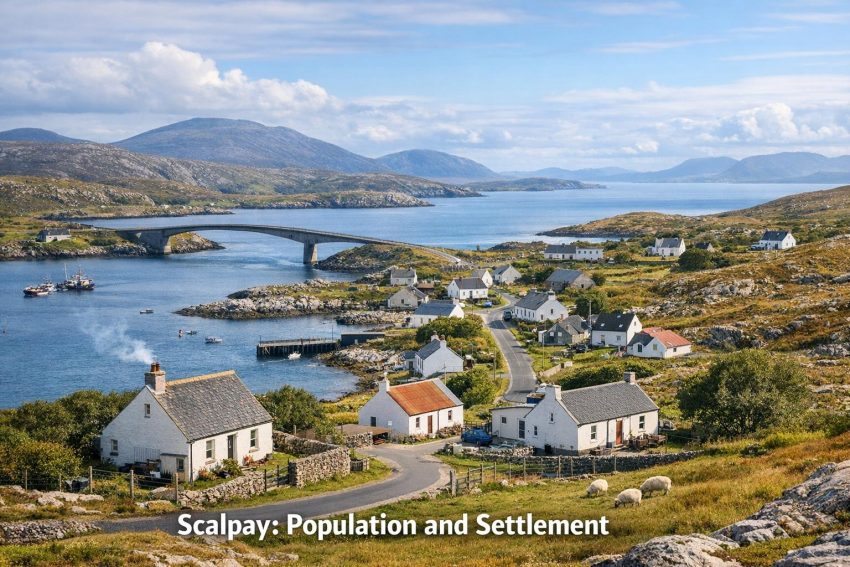
Scalpay is a small inhabited island off the south-east coast of Harris in the Outer Hebrides of Scotland. The narrow Kyle of Scalpay separates it from Harris, though the road bridge opened in 1997 means residents no longer rely on a ferry for routine travel. This physical connection has changed employment, education, shopping and access to public services, yet Scalpay retains its own settlement pattern and community identity.
The island is often called Scalpay, Harris or the Isle of Scalpay to distinguish it from other Scottish places with a similar name. It lies within the Na h-Eileanan an Iar council area and the civil parish of Harris. Census figures place its population at roughly 300 people in recent decades, although the total varies according to the date, geographic boundary and treatment of seasonal residences.
Population size alone does not explain how settlement works on Scalpay. Age structure, household composition, housing use and access to employment matter just as much. An island may retain a broadly steady headcount while losing younger adults, school-age children or year-round households. On Scalpay, the continued presence of permanent residents depends on the close relationship between housing, transport, crofting, maritime work and services on Harris.
Location and physical character of Scalpay
Scalpay covers about 16 to 17 square kilometres. The island has an irregular coastline formed by rocky points, narrow inlets, sheltered bays and small sea lochs. Its interior consists mainly of peatland, exposed rock, rough grazing and low hills. Beinn Scalpay is the highest point, though it rises only to a little over 100 metres.
The land places clear restrictions on settlement. Large parts of the interior are wet, rocky or poorly suited to cultivation and house building. Most homes therefore stand near the coast, along roads or on small areas of more workable ground. The eastern and southern sides contain the main concentration of housing, including the harbour settlement generally known as An Acarsaid.
The island’s position also explains its long reliance on the sea. Before modern roads and motor transport, boats provided access to fishing grounds, neighbouring communities and mainland markets. A sheltered anchorage could determine where a family built a house or stored fishing gear. Even where croft land was available, proximity to the shore remained useful for households combining agriculture with fishing.
Scalpay’s weather has also influenced building form and land use. Strong Atlantic winds, salt exposure and heavy rainfall place demands on roofs, walls and external fittings. Older houses used thick stone walls and low profiles partly because those forms were well suited to exposed conditions. Modern homes use different materials, but builders still need to account for wind loading, drainage and salt corrosion.
Population figures and census interpretation
Scalpay has had a population in the low hundreds through the early twenty-first century. The 2011 Census recorded around 290 residents, with 291 often quoted in island population summaries. Later figures should be read with care because census reporting areas, disclosure controls and island boundaries may not always match the categories used in earlier tables.
A small numerical change can represent a substantial shift at community level. The arrival of four families may add several children to the local population, create demand for housing and increase use of community facilities. The departure of the same number can have the opposite effect. Percentages can therefore look dramatic even where the actual change involves only a few dozen people.
| Population measure | What it can show | Why caution is needed |
|---|---|---|
| Census resident count | People normally living on Scalpay at the census date | Small-area boundaries and reporting methods may change |
| Electoral register | Adults registered to vote at island addresses | It excludes children and may retain people who have moved |
| Household count | The number of occupied residential properties | It does not show household size or age structure |
| School roll | The number of children requiring local education | A small annual change can alter the figure sharply |
| Local estimate | Current knowledge held by residents and community bodies | Definitions of permanent residence may differ |
Second homes and seasonal occupation complicate the picture further. A house may appear well maintained and be used for part of the year without adding to the permanent resident population. Another property may belong to an island family whose members live elsewhere but return regularly. Such homes remain socially connected to Scalpay, though they contribute differently to year-round demand for shops, transport and public services.
Household composition also matters. A population of 300 spread across families with children produces different service needs from the same population made up mainly of one-person and retired households. For local planning, the number of working-age adults, dependent children and residents requiring care is often more useful than a single total.
Long-term population change
Scalpay’s population history reflects broader Hebridean patterns. During the nineteenth and twentieth centuries, many island communities lost residents through migration, changing land use and restricted local employment. People left for mainland Scotland, other parts of Britain and destinations overseas. Glasgow, industrial towns and merchant shipping offered wages that a small croft or inshore fishing boat could not always provide.
Migration was not always permanent. Some people worked away for part of the year, sent money home or returned after retirement. Seafaring created another pattern in which a household remained based on Scalpay while one or more adults spent long periods elsewhere. Population records taken on a single date do not always capture those arrangements neatly.
The decline of older fishing industries also affected settlement. Changes in fish stocks, market prices, harbour requirements and vessel size altered the economic value of small coastal bases. Motor vehicles and centralised services then made it practical to live in one place and work in another. These changes reduced reliance on employment found entirely within the island.
Scalpay did not follow a simple path from growth to decline. Population movement occurred in stages, with periods of relative stability between losses. New residents, returning families and improved transport have offset some departures. Even so, the long-term challenge remains familiar across the Outer Hebrides: retaining enough younger households to balance an ageing population.
Why age structure matters
An ageing population affects nearly every part of community life. Demand rises for accessible housing, home care, medical transport and help with routine tasks. At the same time, fewer working-age residents may be available to provide paid care, maintain property or volunteer for local groups.
Older residents also hold detailed knowledge of croft boundaries, fishing practices, family histories, Gaelic terminology and local place-names. That knowledge forms part of Scalpay’s social record. Population renewal works best when younger households can remain alongside older residents rather than replacing one group with another.
The number of children has an equally direct effect. School-age populations can fluctuate sharply on an island of this size. A handful of births, arrivals or departures may alter the case for local education provision. Parents then consider school travel, childcare and after-school activities when deciding whether island residence is practical.
The form of settlement
Scalpay has no town in the mainland sense. Its built area consists of loose groups of houses, crofts, sheds, religious buildings, community premises and former commercial sites. Development follows the road network and sheltered parts of the coast rather than a dense street plan.
An Acarsaid, a Gaelic name associated with a harbour or anchorage, is the principal settlement area. The name reflects the role of maritime access in shaping habitation. Houses extend beyond the harbour in dispersed groups, and the distinction between one named locality and another may be clearer to residents than it appears on a standard map.
This dispersed form has practical consequences. Homes may sit close enough for regular contact but far enough apart that walking becomes less convenient in poor weather. Delivery routes, refuse collection, road maintenance and utility provision cover a wide area relative to the number of households served. Private vehicles remain central to daily life, especially after the opening of the bridge.
Gaelic place-names and local geography
Gaelic names record how earlier residents identified bays, hills, channels, grazing areas and anchorages. Many refer to physical form, ownership, colour, vegetation or use. They provide a finer-grained account of the island than English-language mapping alone.
Place-name knowledge once had a direct working purpose. Fishers needed agreed names for coastal marks and sea areas, while crofters needed to distinguish grazing and peat-cutting grounds. Oral use passed this knowledge between generations. Formal signs and maps preserve part of it, but regular speech remains the stronger measure of whether a name stays active.
Crofting and land use
Crofting played a central part in the growth of settlement on Scalpay. A croft is a regulated smallholding rather than a large commercial farm. It may provide rough grazing, small cultivation plots, peat rights and access to common grazings. On land as rocky and exposed as Scalpay, crofting rarely supplied a complete household income.
Families commonly combined croft work with fishing, construction, seafaring or paid employment. Livestock could provide food and a modest cash return, while potatoes and other crops reduced dependence on purchased supplies. Peat served as a domestic fuel. Each activity contributed something, even if none could support the household alone.
The crofting pattern also influenced where houses were built. A dwelling might stand near the road while its associated land stretched behind it or lay in several parcels. Common grazing arrangements added another layer of shared land management. Modern property boundaries can therefore sit beside older rights that are not obvious from fences or house plots.
Active croft use helps maintain open ground and controls vegetation through grazing. Where crofts fall out of use, rushes and scrub may spread, drainage channels may close and fencing may deteriorate. Bringing neglected land back into production can be costly, particularly where machinery access is poor.
Crofting now serves economic, environmental and cultural purposes. Few residents rely on it alone, but livestock keeping, land management and food production continue. New entrants face practical barriers such as access to crofts, equipment costs, veterinary travel and small local markets. The work is rarely neat or easy, though that has been true for a long time.
Fishing and maritime employment
The waters around Scalpay supported inshore fishing for generations. Small boats worked close to the island, landing catches for household use or sale. Sheltered bays gave crews places to moor, repair gear and wait for workable conditions. The harbour settlement grew around this relationship with the sea.
Fishing activity changed with boat technology and market demand. Sail gave way to engines, vessels became larger and buyers expected more regular supply. Improved roads allowed catches to move quickly to processors and mainland markets, but centralised landing facilities sometimes reduced the value of very small harbours.
Shellfish have formed part of the modern inshore economy, along with creel fishing and work linked to aquaculture. Employment may include boat operation, maintenance, processing, transport or shore support. Not every maritime worker is directly involved in catching fish.
The sector remains sensitive to fuel costs, regulation, weather and stock condition. A good fishing season does not guarantee steady work throughout the year. Many households still use the older mixed-income model, combining maritime work with construction, transport, crofting or public-sector employment.
The sea as working space
The coastline was never just scenery around Scalpay. It provided food, fuel-related materials, landing places and routes to nearby settlements. Seaweed gathering, shellfish collection and shore work contributed to household economies at various times.
Knowledge of tides, reefs and local weather could determine whether a trip was safe. Such knowledge was learned through repeated work rather than formal charts alone. Modern navigation equipment has reduced some risks, but local judgement still matters in narrow channels and exposed waters.
The Scalpay Bridge and road connection
The Scalpay Bridge opened in 1997, replacing the ferry across the Kyle of Scalpay. Before then, residents depended on scheduled crossings for vehicles, goods and routine journeys. Weather, ferry capacity and operating hours placed constraints on work, education and medical travel.
The bridge created direct road access to Harris. Residents could drive to Tarbert and other settlements without waiting for a ferry, while delivery vehicles and emergency services gained easier access to Scalpay. Commuting became more practical, broadening the range of jobs available to island residents.
The change was especially relevant for families with children and people attending medical appointments. A fixed crossing reduced uncertainty and removed the need to plan ordinary trips around a ferry timetable. It also helped tradespeople bring tools and materials to island properties.
The bridge did not remove every transport difficulty. Travel to many services still takes time, fuel costs remain high and poor weather can affect roads. Trips beyond Harris may involve ferry or air travel from other parts of the Outer Hebrides. Scalpay became road-connected, but it did not become geographically close to major service centres.
Effects on local commerce
Road access can support local businesses by making deliveries easier and allowing customers to visit. It can also draw spending away from the island because residents gain easier access to shops and services on Harris. Both effects have occurred in bridge-connected island communities.
A small Scalpay business competes with suppliers elsewhere while serving a modest resident market. Operators often need several income streams or customers beyond the island. Online sales and remote services can help, provided broadband, delivery arrangements and workspace are adequate.
The bridge also made short tourist visits easier. Visitors can drive across, walk part of the island and leave the same day. That increases traffic but does not always produce much local spending. Accommodation, food and paid activities generate more resident income than passing visits alone.
Housing and permanent residence
Scalpay’s housing stock includes older stone houses, twentieth-century homes, newer detached properties and renovated croft buildings. Some houses remain attached to working crofts, while others stand on separate plots. The open settlement pattern leaves grassland, exposed rock and garden ground between many buildings.
The number of buildings should not be mistaken for the number of homes available to local residents. A structurally sound property may be used as a holiday let, second home or inherited family house. Another may remain empty because renovation costs exceed its market value. These properties exist, but they do not necessarily meet demand for permanent rental housing.
Younger adults may find it hard to form an independent household on the island even when family property is present. Ownership may be shared between relatives, legal titles may require work, or a house may need major repairs. Long-term private rentals are scarce because seasonal letting can produce higher returns during visitor months.
New construction presents its own problems. Materials travel long distances, skilled labour may need accommodation and exposed sites require suitable building methods. Groundworks on peat or rock can add expense. Weather delays are common enough to be treated as a normal project risk rather than an unusual event.
Second homes and holiday accommodation
Seasonal properties bring mixed effects. Owners spend money on repairs, local services and supplies, while visitors support tourism businesses. Family-owned houses also allow people with Scalpay connections to return for holidays, funerals, weddings and community events.
Yet a high share of seasonal use can reduce the number of neighbours present through winter. It can weaken demand for year-round services and raise house prices beyond local wages. The effect depends on scale, property type and whether new visitor accommodation replaces or supplements permanent homes.
Local housing policy therefore has to distinguish between vacancy, seasonal use and actual availability. An empty house needing major structural work is not equivalent to a ready-to-occupy rental. Accurate property data helps housing associations and public bodies assess demand rather than relying on appearances.
Housing as a population issue
Employment initiatives have little effect on population retention if workers cannot secure suitable homes. The same applies to families returning to Scalpay after study or work elsewhere. They may have income and family connections but still lack a viable property.
Affordable rental homes, serviced plots and renovation support can each serve different groups. Older residents may need smaller accessible houses, freeing larger family homes. Croft housing can assist some applicants, though land rights and planning requirements require careful handling.
Gaelic language and island identity
Scottish Gaelic has long been part of life on Scalpay. It appears in place-names, family speech, songs, oral history and religious practice. Earlier generations commonly used Gaelic as their home and community language, with English playing a greater role in formal education and dealings beyond the island.
Language use shifted during the twentieth century as English became more common in schools, broadcasting and employment. Migration also affected transmission within families. Parents who spoke Gaelic sometimes raised children mainly in English because they believed it would help with education and work.
Gaelic remains present, but fluency and frequency of use vary by age and household. A resident may speak it daily, understand it without speaking often, or have learned it through school. Census questions capture some of this variation, though they cannot measure every form of cultural use.
The survival of island Gaelic depends partly on ordinary conversation. Signs and public programmes give visibility, but a language remains socially active when people use it at home, in community meetings and during work. Contact between fluent older speakers and younger learners can support that continuity.
New residents do not need family roots on Scalpay to take part in local life. Learning pronunciation, place-names and common Gaelic phrases can help them relate to the island’s history. Integration tends to work through regular participation rather than formal declarations of belonging.
Religion, social ties and voluntary activity
Religious observance has historically influenced weekly routines and social life across Harris and Scalpay. Churches provided places of worship, meeting spaces and networks of practical support. Patterns have changed, but congregations remain part of the social structure for many residents.
Family networks are equally influential. Relatives may live on neighbouring crofts, elsewhere on Harris or much farther away. These connections help with childcare, transport, building work and care for older people. They also explain why people who live away may continue to regard Scalpay as home.
Voluntary groups perform work that larger settlements often assign to staffed organisations. Residents may organise events, maintain halls, raise funds, support vulnerable neighbours and represent local concerns to public bodies. With a few hundred residents, the same people can end up serving on several committees. It is useful work, though the meeting calendar can get a bit crowded.
Community capacity should not be measured only by the number of registered groups. Informal help matters too. Checking on a neighbour after bad weather, collecting medicine or sharing transport may never appear in official records, yet such activity supports permanent settlement.
Education and family life
Education provision is closely linked to population structure. A local school can reduce travel for young children and provide a centre for community activity. Falling pupil numbers, however, make small-school provision expensive on a per-child basis and can lead authorities to review arrangements.
Where pupils travel to Harris, families must fit daily routines around transport schedules. Secondary education generally requires travel beyond the immediate island in any case. Weather, road conditions and after-school activities add practical questions that mainland families living near a school may rarely face.
Further and higher education often require young people to leave the area. Some study through online courses or Outer Hebrides institutions, but many move to mainland Scotland. The issue is not departure itself; education-related movement is normal. The harder question is whether graduates can later find housing and work that allow them to return.
Childcare also affects family settlement. Formal provision may be farther away or operate on hours that do not match shift work. Relatives often fill the gap, though this option is not available to every household. New families without local kin may need dependable paid provision before accepting work.
Healthcare and support for older residents
Scalpay residents use healthcare services on Harris and elsewhere in the Outer Hebrides. Routine appointments may be manageable by road, while hospital treatment and specialist care can require longer journeys. Travel to the mainland may involve a ferry or flight as well as onward road transport.
The bridge improved access for ambulances, carers and patients, but distance still affects appointment planning. Older residents who no longer drive may depend on relatives, community transport or public services. Winter weather can add delays and make early appointments less practical.
Home care allows many people to remain on the island for longer, provided staff are available. Recruitment can be difficult because carers need housing and must travel between dispersed homes. Adaptations such as ramps, accessible bathrooms and improved heating also support ageing in place.
Digital consultations can reduce some travel, especially for follow-up appointments. They work best as a supplement to physical care rather than a replacement. Reliable broadband, private space and confidence using devices all affect whether remote appointments are useful.
Employment and the modern island economy
Modern employment among Scalpay residents is spread across several sectors. Fishing, aquaculture and crofting remain present, while construction, transport, retail, tourism, care, education and public administration provide other forms of work. Some residents commute to Harris, and others work on rotation farther away.
Small businesses often combine local and external customers. A tradesperson may work on Scalpay and across Harris. A tourism operator may earn most income during summer, then take other work during winter. Remote workers can serve employers based anywhere in Britain, assuming communications remain dependable.
This mixed pattern reduces reliance on one industry but creates income variability. Seasonal work, self-employment and short contracts can make mortgage applications or rental commitments harder. Fuel, insurance and freight costs also take a larger share of household and business budgets than they might in an urban area.
Remote work and broadband
Better digital connections have expanded the range of jobs that can be done from Scalpay. Administrative work, design, accountancy, customer support and online teaching do not always require a daily trip to an office. Remote employment can suit residents who value island residence but need access to a wider labour market.
Coverage quality may differ between properties because of terrain, building construction and network technology. A service advertised for the island may perform well in one settlement and poorly behind a hill. Backup mobile access can be useful for households dependent on online work.
Remote work does not remove the need for local services. Workers still need housing, transport, healthcare and social contact. It does, however, weaken the old assumption that every permanent resident must earn most income within a few miles of home.
Transport beyond the bridge
The bridge connects Scalpay to the Harris road network, but longer trips remain shaped by island transport. Tarbert provides ferry connections and local services, while travel to Stornoway gives access to a broader range of shops, administration and medical care. Road distances can be time-consuming despite appearing modest on a map.
Public transport is valuable for residents who do not drive, though timetables must serve a dispersed and small population. Evening and weekend options may be fewer than weekday services. Taxi availability can also vary, particularly during busy visitor periods.
Freight transport affects food prices, construction and business activity. Goods generally pass through several stages before reaching a Scalpay address. Delays at any stage can affect building schedules or retail stock. The bridge removed one transfer point, which made logistics easier, but did not eliminate the costs associated with Outer Hebridean transport.
Tourism and seasonal population
Visitors come to Scalpay for coastal walks, wildlife, views across the Minch and the island’s maritime history. The road connection allows day trips from Harris, while self-catering accommodation supports longer stays. Eilean Glas Lighthouse, at the eastern end of the island, is among the better-known visitor destinations.
Tourism can support accommodation providers, cleaners, tradespeople, food businesses and activity operators. Visitor spending is most useful to the resident economy when it reaches locally run businesses and creates paid work beyond a short summer peak.
Seasonal demand also places pressure on roads, parking, waste collection and accommodation. Some island roads are narrow, with passing places intended to keep traffic moving rather than act as parking bays. Visitors unfamiliar with single-track driving can slow journeys for residents and service vehicles.
The relationship between tourism and housing requires particular care. Converting a permanent rental into short-stay accommodation may raise revenue for an owner but remove a home from the resident market. Purpose-built visitor accommodation has a different effect, especially if it creates work without reducing the existing housing supply.
Tourism alone cannot sustain every aspect of island life. Visitor numbers fall outside the main season, while care, transport and education must operate through the year. A durable resident economy therefore draws income from several sources rather than relying on holiday demand.
Public services and community viability
Providing services to a small island population carries higher per-person costs than providing the same service in a large town. Roads, utilities, refuse collection and care routes cover long distances for relatively few users. Standard population thresholds do not always reflect the role a service plays in keeping a community viable.
A facility can have value beyond its main function. A community building may host meetings, exercise classes, cultural events and emergency coordination. Closing such a facility may save one budget line while increasing travel and weakening several forms of local activity.
Service planning also needs to account for winter conditions and residents without cars. A shop or clinic that appears close by road may still be hard to reach for an older person during poor weather. Distance should be measured in practical travel time, not miles alone.
Scalpay’s connection to Harris allows many services to be shared. This arrangement makes sense for specialist provision, but basic access still needs reliable transport and clear scheduling. The bridge provides the physical route; service design determines whether residents can use it effectively.
Settlement pressures and future population
The future population of Scalpay will depend less on attracting large numbers than on maintaining a workable mix of residents. A few new or returning families can improve age balance, increase demand for local provision and add workers to the island economy. The scale is small, so modest interventions can have visible effects.
Housing availability remains central. Employment cannot retain people who have nowhere suitable to live. Renovation grants, affordable homes, serviced plots and clearer routes into croft housing can address different parts of the problem.
Employment variety also matters. Fishing and crofting retain cultural and economic value, but most households require income from other sectors. Construction, care, tourism, public services and remote work can operate alongside traditional activities.
Transport and communications connect residents with Harris and employers farther away. The bridge settled the question of routine vehicle access, though public transport, road maintenance and digital reliability still affect daily choices.
Age balance may be the clearest measure of community health. A stable total can conceal fewer children and more older residents. Monitoring school rolls, housing demand and working-age migration provides a fuller account than census totals alone.
Community participation supports shared facilities and local representation. Yet voluntary effort has practical limits. Residents cannot replace every public service through fundraising and committee work, and expecting them to do so may place too much pressure on a small group.
Scalpay as a permanent Outer Hebridean community
Scalpay’s settlement grew from the combined use of croft land, sheltered coastline and fishing grounds. Houses were placed where families could reach both shore and grazing, producing the dispersed pattern still visible today. Later roads, modern housing and the bridge altered movement without erasing that earlier structure.
The island now functions in close association with Harris. Residents commute, attend school, shop and receive care across the bridge. This connection supports permanent residence, though it also means fewer activities need to be provided within Scalpay itself.
Population figures near 300 describe the scale of the community but not its full condition. Permanent occupancy, age profile, available housing and local employment give a more accurate account. Seasonal houses may add activity during summer while contributing little to winter population. Older residents may keep household numbers steady even as fewer children live nearby.
Scalpay does not need rapid growth to remain inhabited. It needs a steady supply of usable homes, dependable transport, varied work and services suited to a small population. Returning islanders and newcomers can both contribute where those conditions exist.
The island’s future is therefore tied to continuity as much as change. Crofting, Gaelic place-names and maritime work connect present settlement with earlier generations. The bridge, broadband and commuting reflect current economic life. Keeping both sides of that relationship intact gives Scalpay the best prospect of remaining a year-round community rather than a settlement occupied mainly during holiday periods.