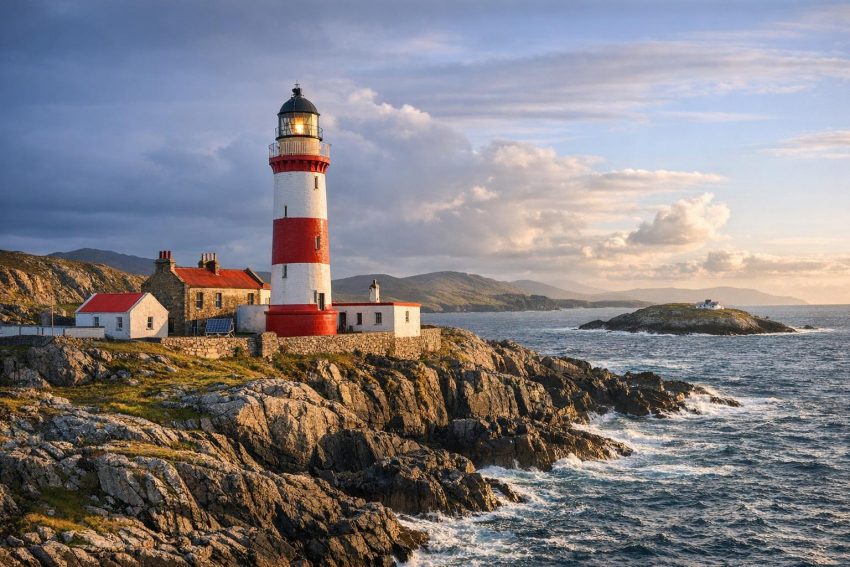
Eilean Glas Lighthouse stands at the eastern end of Scalpay, a small island beside Harris in the Outer Hebrides of Scotland. From this exposed headland, the light marks the southern approach to the Minch, the channel separating the Outer Hebrides from the north-west coast of mainland Scotland. Established in 1789, Eilean Glas was among the first four lighthouse stations commissioned by the Northern Lighthouse authorities.
The station is notable for both its age and its appearance. The present masonry tower, built in the early nineteenth century, has broad red bands that make it easy to identify during daylight. Around it sit former keepers’ houses, stores, boundary walls and service buildings. Together, these structures show how a remote lighthouse functioned before electric lamps, radio communication and automatic monitoring reduced the need for resident staff.
Eilean Glas still operates as a navigational aid, although keepers no longer live at the station. It also serves as a well-known walking destination on Scalpay. Reaching it requires a coastal walk across open moorland and rough ground, so the visit is rather different from pulling into a roadside viewpoint, taking two photographs and moving on.
Where is Eilean Glas Lighthouse?
Scalpay lies immediately east of the Isle of Harris and forms part of the Outer Hebrides, also called the Western Isles. A road bridge connects Scalpay with Harris, allowing visitors to reach the island without using a ferry. The lighthouse is positioned on Eilean Glas, the rocky eastern headland of Scalpay, several miles from the island’s main settlement and road network.
The name Eilean Glas comes from Scottish Gaelic. Eilean means island, while glas can describe shades of grey, green or blue-green. English translations vary between “green island” and “grey island”. Both make reasonable geographic sense because the colour of the headland changes with the vegetation, weather and light. Hebridean place names rarely worry about neat English categories.
Although the name suggests a separate offshore island, the lighthouse site is normally approached over land from Scalpay. Narrow channels and low-lying ground around the headland can give it an island-like appearance, particularly when viewed from the sea. The distinction matters less to a mariner than the headland’s position. It projects into open water and forms a clear reference point on approaches from the Minch.
The surrounding terrain consists mainly of exposed rock, peat, rough grass, small lochs and low coastal vegetation. There are few trees and almost no tall structures to block the line of sight. On clear days, views extend across the Minch to the mainland and north or south along parts of the Hebridean coast.
This openness comes with harsh weather. The station receives strong winds, salt spray, heavy rain and rapidly changing cloud. Mist can remove distant views within minutes. Winter storms place considerable pressure on roofs, masonry, windows and metal fittings. Such conditions influenced every part of the station’s design, from the thickness of the tower walls to the organisation of fuel and food supplies.
The maritime position of Scalpay
Scalpay occupies a useful position between the sheltered coastal waters of Harris and the wider Minch. Vessels travelling north or south through the Minch pass close to many islands, reefs, promontories and rocky skerries. Other routes lead through the Sound of Harris, into local anchorages or westward toward the Atlantic Ocean.
Before modern electronic equipment, mariners relied heavily on direct observation. Headlands, mountain outlines, church towers and other visible features helped crews establish their position. At night or in poor visibility, those references became difficult to use. A light placed on the eastern point of Scalpay gave vessels a recognised bearing and warned them of the nearby coast.
The Minch may look broad on a map, but local conditions can make passage demanding. Atlantic weather reaches the channel through gaps between the islands and around the northern and southern ends of the Outer Hebrides. Tidal streams interact with shoals and headlands, producing rough water in some areas. Rain, haze and sea fog can reduce visibility with little warning.
Fishing boats, cargo vessels, naval ships, passenger steamers and local craft have all used these waters. Each type of vessel has different operating requirements, yet all benefit from an accurately charted light. Eilean Glas became part of a chain of aids that allowed crews to identify their position and maintain a safe course along the western seaboard.
Why the lighthouse was established
During the eighteenth century, coastal trade around Scotland increased steadily. Fishing fleets ranged farther from their home ports, merchant vessels carried goods between regional harbours, and naval activity placed more ships in northern waters. Scotland’s coastline remained poorly lit, despite its many reefs, islands and narrow channels.
Parliament established the Commissioners of Northern Lighthouses in 1786. The organisation later became widely known as the Northern Lighthouse Board. Its original task was to provide lights around the northern parts of Scotland, where private or local harbour lights offered little help to ships travelling between ports.
Eilean Glas was selected as one of the first four stations commissioned by the new authority. The others were Kinnaird Head in Aberdeenshire, North Ronaldsay in Orkney and the Mull of Kintyre. These sites covered widely separated routes and demonstrated the scale of the work facing the commissioners.
The placement of a light on Scalpay addressed a practical gap. Ships approaching the Minch from the south needed a recognised coastal mark before continuing north or entering nearby channels. The eastern point of Scalpay offered enough elevation and a broad line of sight across the water. Its remote position complicated construction, but a more convenient site would not have served the same navigational purpose.
Thomas Smith and the first light of 1789
The original Eilean Glas Lighthouse was designed by Thomas Smith, an engineer, architect and lamp maker from Edinburgh. Smith became the first engineer to the Northern Lighthouse Commissioners and played a major part in establishing Scotland’s organised lighthouse service.
Smith had worked on street lighting and improved reflector systems before receiving lighthouse commissions. This background suited an era when the optical apparatus mattered as much as the tower. Early lamps produced far less light than later electric equipment, so engineers had to make careful use of reflectors, lamp placement and lantern glazing.
Building work at Eilean Glas took place under difficult conditions. Stone, timber, metal fittings, food and tools had to reach Scalpay and then be moved to the headland. Sea transport depended on weather, while overland movement crossed wet and irregular ground. Workers also needed accommodation at or near the construction site.
The first lighthouse was completed and lit in 1789. It was a smaller structure than the tower seen today. Its lamp and reflector equipment would appear modest beside a modern marine lantern, but at the time it represented a major improvement for ships using the Minch.
Early lighthouse lamps commonly burned oil and required close supervision. Keepers trimmed wicks, polished reflectors, cleaned soot from lantern glass and maintained a steady fuel supply. Poor maintenance could reduce the visible range of the light. A dirty pane or badly adjusted wick was not a minor housekeeping issue; it directly affected the usefulness of the station.
The 1789 light made Eilean Glas one of the oldest established lighthouse sites in Scotland. The present tower is not, however, wholly the original eighteenth-century structure. As traffic increased and lighthouse engineering improved, the station received a taller and more capable replacement.
Robert Stevenson and the present tower
The current lighthouse tower dates from 1824 and is associated with Robert Stevenson, one of the best-known engineers employed by the Northern Lighthouse Board. Stevenson was Thomas Smith’s stepson and professional successor. He designed or supervised many Scottish lighthouses, including the celebrated Bell Rock Lighthouse off the coast of Angus.
By the 1820s, the Northern Lighthouse Board had gained several decades of operational experience. Engineers had better knowledge of tower construction, lantern design and optical performance. The replacement at Eilean Glas reflected a move toward taller towers and stronger lights that could serve increasing maritime traffic.
The present tower rises to about 30 metres. Its lantern stands at a greater elevation above sea level because the tower occupies raised coastal ground. This height extends the geographic range at which a ship can see the light, subject to weather and the observer’s own height above the water.
The tower is built from masonry and has the tapered form associated with traditional lighthouse engineering. A broad base provides stability, while the narrowing upper section reduces weight and wind pressure. An internal stair gives access to service levels and the lantern room. The external gallery near the top allows inspection of the lantern glazing and surrounding structure.
Eilean Glas has a highly recognisable daytime appearance. The white tower carries two broad red horizontal bands, with a dark lantern structure above. This colour scheme acts as a daymark. Crews can distinguish the tower from other pale lighthouse buildings and compare what they see with charts, sailing directions or electronic chart displays.
The bands also give the station its familiar visual identity. They are practical rather than decorative, though the result is certainly less plain than the standard all-white tower. Paint exposed to Hebridean weather requires regular attention because wind-driven rain and salt can wear down coatings faster than at a sheltered inland building.
Core facts about the lighthouse
| Feature | Details |
|---|---|
| Location | Eastern Scalpay, Outer Hebrides, Scotland |
| Original light established | 1789 |
| Designer of the first lighthouse | Thomas Smith |
| Present tower completed | 1824 |
| Engineer associated with the present tower | Robert Stevenson |
| Approximate tower height | 30 metres |
| Daymark | White tower with two broad red bands |
| Automation | 1978 |
| Operating authority | Northern Lighthouse Board |
Published light characteristics, nominal ranges and operational notices may change. Mariners should use current official charts, Notices to Mariners and lighthouse lists rather than visitor material when planning a passage.
How the lighthouse light works
A coastal light must be identifiable as well as visible. If every lighthouse displayed an uninterrupted white beam, mariners could easily confuse one station with another. Lighthouse authorities therefore assign each light a characteristic based on colour, flash pattern and timing.
Eilean Glas has used different apparatus during its long service. Early oil lamps and reflectors gave way to more efficient optical systems. Fresnel lenses, named after French physicist Augustin-Jean Fresnel, allowed lighthouse engineers to concentrate light into a powerful beam without using an excessively thick and heavy lens.
A Fresnel lens consists of concentric sections that bend light in a controlled direction. The arrangement reduces the amount of glass while preserving optical performance. In a rotating apparatus, separate lens panels can produce flashes as the beams sweep past an observer. Clockwork mechanisms once drove the rotation, rather like a large and very purposeful clock.
Keepers had to wind the mechanism at set intervals and check that it ran at the correct speed. If the machinery slowed, the flash pattern could change. The station log recorded inspections, maintenance, weather and any operational problem. These records created an account of daily work that often continued for decades.
Modern lighthouse lamps require far less direct attention. Electric light sources, automatic lamp changers, batteries and control systems allow a station to operate without a keeper in permanent residence. Remote telemetry can report a fault to technical staff. Engineers still visit the site for inspection and repair, since automation has yet to persuade salt water to stop corroding metal.
Visible range and weather
The distance at which a lighthouse can be seen depends on more than lamp power. The elevation of the light and the height of the observer set the geographic range because the curvature of the Earth eventually hides low objects below the horizon. A crew member on a ship’s bridge may see a light sooner than someone standing close to the water on a small boat.
Atmospheric conditions then affect the luminous range. Clear, dry air can allow a light to remain visible at a considerable distance. Mist, heavy rain, spray and low cloud absorb or scatter light. In thick fog, even a powerful lighthouse may disappear from view.
This is why professional navigation never rests on one aid alone. Mariners compare visual bearings with radar, depth readings, buoys, satellite positioning, electronic charts and known tidal conditions. The lighthouse remains useful, but it forms one part of a broader navigational system.
Buildings at the lighthouse station
A remote lighthouse station needed much more than a tower. Before automation, keepers and their families could spend long periods at Eilean Glas. The site required houses, stores, workshops, water arrangements, fuel storage and routes for bringing supplies from landing points or settlements.
The former keepers’ accommodation stands close to the tower. Domestic buildings at lighthouse stations were generally plain and orderly, reflecting official standards rather than local building traditions alone. Thick walls and secure roofs offered protection from wind and rain. Windows provided natural light but had to withstand repeated exposure to salt and storms.
Store buildings held lamp oil, tools, spare parts and household supplies. Oil storage demanded care because fuel presented a fire risk near living quarters and lighting apparatus. Workshops gave keepers space to repair equipment, prepare paint and perform routine maintenance.
Boundary walls and paths organised movement around the station. Walls could offer some shelter at ground level, though they did little to tame the strongest gales. Proper paths reduced damage to wet ground and made it easier to carry fuel or equipment between buildings.
Water supply was another routine concern. Remote stations could not depend on municipal pipes, so rainwater collection, tanks, wells or local sources were used according to site conditions. Dry spells, contamination or damage to storage systems had direct consequences for resident families.
Landing places and supply routes linked the station with the rest of Scalpay. Deliveries by sea depended on tides, swell and wind direction. Moving heavy goods ashore was hazardous in rough conditions, and bad weather could delay supplies. Later road and bridge improvements made Scalpay easier to reach, although the final approach to Eilean Glas remains isolated.
Daily life for Eilean Glas lighthouse keepers
Lighthouse keeping followed a disciplined schedule. The central duty was to keep the light operating according to the published characteristic from sunset to sunrise. The work varied as equipment changed, but cleanliness, observation and accurate record-keeping remained constant.
Before electric operation, a keeper prepared the lamps in daylight. This meant cleaning burners, trimming wicks, checking oil, polishing metal reflectors and washing lantern panes. Soot or condensation could reduce light output. Lens surfaces also required careful handling because scratches and residue affected optical performance.
Rotating equipment had to move at the correct rate. Keepers wound clockwork drives, inspected gears and listened for irregular movement. Temperatures inside the lantern could vary sharply, and strong wind placed pressure on the glazing and metal frame. Any leak needed prompt treatment before water reached the apparatus.
Work outside the tower included painting, masonry repair, clearing drains and maintaining paths. Salt attacked exposed fittings, while damp entered small defects in roofs and walls. A neglected job could become a much larger repair after one winter storm.
Keepers also made weather observations and recorded events in the station log. Entries might cover wind direction, visibility, sea conditions, equipment checks, passing vessels and supply deliveries. The style was usually factual. Official logs leave little room for literary flourish, even when the weather plainly deserved comment.
Family and community life
Some keepers lived at Eilean Glas with their families. Domestic life continued alongside the formal duties of the station. Food preparation, washing, schooling and childcare took place in an area distant from shops, medical care and other services.
Scalpay’s community reduced the isolation to a degree. Keepers could maintain contact with island residents, obtain local help and take part in community life when duties permitted. Even so, the walk between the lighthouse and settlement was affected by weather and ground conditions. A routine visit became awkward during heavy rain or strong wind.
Families had to plan supplies carefully. Flour, preserved food, lamp fuel, coal and household goods could not always be replaced at short notice. Fresh produce was less dependable than it would be in a town. Some stations kept gardens, though exposed coastal soil and salt spray did not make horticulture easy.
Children living at remote stations faced practical questions around schooling. Arrangements differed by date, staffing pattern and distance from local schools. Some families lived apart for periods, while others managed education from the station or travelled when conditions allowed.
The work also demanded cooperation between keepers. Larger stations usually had more than one member of staff so that watches, maintenance and leave could be arranged. Clear procedures mattered because illness, injury or equipment failure could occur while outside assistance was delayed.
Oil, optics and electric power
The history of Eilean Glas reflects broad changes in lighthouse engineering. The first light relied on oil-burning equipment and metal reflectors. Later lamps produced brighter and steadier flames, while improved lenses directed more of that light toward the horizon.
Different fuels were adopted across the Scottish lighthouse service over time. Whale oil, vegetable oils, mineral oil and paraffin all appeared during different periods. Each fuel had practical consequences for storage, transport, burner design and cleaning. A brighter lamp might improve range but require new tanks, ventilation or handling procedures.
The introduction of Fresnel optics during the nineteenth century changed lighthouse performance. Large lens assemblies could send concentrated beams far out to sea. Rotating panels produced recognised flash groups, allowing Eilean Glas to be distinguished from nearby lights.
Electrification removed much of the daily work associated with wicks and liquid fuel. Electric lamps could provide reliable output, while backup systems protected against a single lamp failure. Motor drives replaced wound clockwork in rotating apparatus. Control units later allowed functions to be checked without constant human attendance.
Modern marine lanterns may use compact optical equipment rather than the large rotating lens assemblies associated with older lighthouses. Light-emitting diodes have also become common at many stations because they use less electricity and last longer than conventional lamps. The apparatus installed at any working lighthouse may be altered as the operating authority updates equipment.
Automation in 1978
Eilean Glas Lighthouse was automated in 1978. The change ended the station’s need for permanent resident keepers, although technical visits continued. Automation formed part of a wider programme across Scotland as dependable electrical controls and remote reporting became available.
An automated station can switch the light on and off according to ambient conditions, monitor power, activate backup equipment and report faults. These functions reduce staffing costs and remove the need for families to live in remote accommodation. They also change the character of the site.
Without resident keepers, domestic buildings no longer receive daily heating, ventilation or minor repairs. Empty properties can deteriorate quickly, particularly on a wet Atlantic coast. A blocked gutter, slipped slate or damaged window may allow water into the structure long before the next scheduled inspection.
The lighthouse itself remains an operational aid maintained by the Northern Lighthouse Board. Former residential and service buildings may follow different ownership or management arrangements. This separation is common at automated stations, where the authority needs continued access to the tower but no longer requires every domestic building.
Eilean Glas as a daymark and sea mark
The broad red bands on Eilean Glas help crews recognise the tower during daylight. Nautical charts and sailing directions describe a lighthouse’s shape, colour and position, allowing mariners to compare the charted mark with the structure visible from the vessel.
Daymarks remain useful despite satellite navigation. Electronic position data can fail through power loss, damaged equipment, poor configuration or incorrect chart use. A visible and correctly identified lighthouse gives an independent check. If the plotted position disagrees with what the crew can see, someone needs to examine the reason.
The tower also helps local vessels judge their position relative to nearby channels and anchorages. Fishing crews with long experience of the area may use familiar alignments between headlands, hills and buildings. Such local references support, rather than replace, formal navigation.
At night, the flash characteristic performs the identifying role. A crew times the flashes and compares the pattern with charted data. The colour and repetition period separate Eilean Glas from lights elsewhere around Harris and the Minch.
Heritage and architectural status
Eilean Glas belongs to the earliest period of organised lighthouse construction in Scotland. The 1789 foundation of the station links it with the first programme undertaken by the Northern Lighthouse Commissioners, while the 1824 tower records the work of Robert Stevenson.
The association with both Thomas Smith and Stevenson gives the site added engineering interest. Their work spans the transition from early reflector lights to more advanced nineteenth-century towers and optical apparatus. Eilean Glas shows that progression in one location.
The station buildings have recognised architectural and historical value under Scotland’s building protection system. Formal listing controls alterations that could affect the character of protected structures. It does not require a property to remain frozen in time, but repairs and new uses need suitable materials and appropriate consent.
The value of the station is not confined to the tower. Keepers’ houses, stores, walls and access routes show how the light was supported. Removing those structures from the account would reduce the site to a striped tower and miss much of its working history.
Conservation on an exposed coast
Repairing buildings at Eilean Glas requires methods suited to a marine climate. Salt enters porous stone and mortar, then crystallises as moisture evaporates. Repeated wetting and drying can weaken surfaces. Metal expands as it corrodes, which may crack surrounding masonry.
Wind-driven rain finds openings that would cause few problems at a sheltered property. Roof coverings, flashings, chimneys and window frames need close inspection. Traditional lime mortar may allow old masonry to release moisture more effectively than hard modern cement, though every repair must be assessed by qualified conservation professionals.
Transport adds cost and delay. Materials and tools must cross Scalpay and then reach the headland. Heavy machinery may not have easy access, while ground conditions restrict vehicle movement. Work schedules also depend on weather. Applying coatings during persistent rain is rarely a winning plan.
A practical conservation programme normally gives priority to keeping water out, securing unsafe areas and maintaining ventilation. Decorative work comes later. Regular small repairs often cost less than rebuilding walls or roof structures after prolonged water entry.
Walking to Eilean Glas Lighthouse
The lighthouse is reached on foot from Scalpay. The recognised route commonly begins near the end of the public road in the eastern part of the island and crosses moorland toward the coast. Exact parking arrangements, path conditions and route markings can change, so visitors should check local notices before setting out.
The return walk is commonly treated as a half-day outing, depending on the chosen route, pace and conditions. Distances quoted by walking sources vary because some routes use a direct return while others form a longer circuit. The ground may include wet peat, stone, rough grass, narrow paths and short steeper sections.
Sturdy waterproof footwear is sensible even after a dry spell. Rainwater can remain in peat and hollows for days. A waterproof jacket and spare warm layer are also advisable because the headland receives little shelter. Wind at the lighthouse may be much stronger than it was near the starting point.
Visitors should carry drinking water, food, a map and a reliable means of checking position. Mobile reception cannot be assumed across every part of the route. An offline map is useful, but a charged phone should not be treated as the only form of route finding.
Daylight allowance matters outside summer. Progress across wet ground may be slower than expected, and photography or stops at the station add time. Turning back early is sensible if cloud, wind or heavy rain makes the route hard to follow.
Access to the tower and buildings
Reaching the lighthouse grounds does not mean that the tower or former keepers’ houses are open for entry. Eilean Glas remains an operational station, and parts of the property may be locked, privately managed or closed for safety reasons.
Visitors should follow signs and remain outside fenced or secured areas. Operational equipment, electrical systems and external galleries are not public viewing platforms. Current opening arrangements, if any, need to be confirmed locally before travel.
The safest assumption is that a visit provides exterior views of the station and surrounding coast. Any formal building access should be treated as an added opportunity rather than a guaranteed part of the walk.
Wildlife around the headland
The coast near Eilean Glas supports seabirds and marine animals associated with the Minch. Depending on season and sea conditions, walkers may see gannets, fulmars, gulls, shags, cormorants and other coastal birds. Sea eagles are also present in the Outer Hebrides, though a sighting cannot be promised on schedule.
Seals may appear around rocky shores, often with little more than a head visible above the water. Dolphins and porpoises use the Minch, and larger whales occasionally pass through. Calm weather and patient observation improve the chance of seeing marine life.
Birds may nest on cliffs, rocky ledges or open ground. Walkers should avoid approaching nests and should keep dogs under close control. A bird repeatedly leaving its nest or circling while calling is usually a good indication that a visitor has come too close.
The ground may also support grazing livestock. Gates should be left as found, and dogs should remain controlled around sheep. Visitors should take litter away and avoid removing stones, fittings or other material from the station.
Scalpay and its connection with Harris
Scalpay has a small resident community with long associations with fishing, crofting and maritime transport. Its sheltered natural harbour supported local boats, while nearby waters provided access to fishing grounds and trading routes.
For much of its history, the island depended on boats for regular contact with Harris. The Scalpay Bridge, opened in 1997, replaced the former ferry connection and gave residents direct road access to Harris. The bridge altered daily travel for work, education, shopping and medical services.
The island retains a close cultural relationship with Harris and the wider Outer Hebrides. Scottish Gaelic remains part of local identity, place names and community life. Names record physical features, land use and older patterns of settlement, even where their English translations vary.
Visitors often combine the lighthouse walk with time elsewhere on Scalpay or Harris. Tarbert, the main settlement on Harris, provides shops, accommodation and ferry connections. Roads across North Harris pass through mountainous ground, while South Harris is known for broad beaches, machair and crofting townships.
Eilean Glas should be allowed enough time in its own right. The walk, station buildings and sea views make a rushed visit impractical. Trying to fit it between several distant stops can turn a straightforward outing into an exercise in checking the clock.
Photography at Eilean Glas
The red-banded tower offers a clear subject against grey rock, green moorland and open sea. Its colour contrast remains effective in flat light, which is useful given the frequency of cloud in the Hebrides.
Wide views can show the relationship between the station and the Minch. A longer focal length can isolate the lantern, gallery or patterns in the masonry. Former keepers’ buildings provide context and prevent every image from becoming the same upright tower photograph.
Wind creates practical problems for tripods, particularly near exposed ground and cliff edges. A lower tripod position and faster shutter speed may help. Salt spray can collect on lenses, so a cloth is worth carrying. Lens changes should be made with care during rain or blowing grit.
Drones are subject to aviation rules, landowner permission, wildlife restrictions and operational concerns around lighthouse equipment. Flying close to buildings, people or nesting birds may be prohibited or irresponsible even where general airspace rules appear to permit flight. Local restrictions should be checked before arrival.
The lighthouse in modern navigation
Satellite positioning has changed bridge practice, but it has not made physical lights obsolete. Ships use integrated displays that combine position, radar and chart data. Visual observations remain a practical cross-check against equipment errors and incorrect settings.
Small fishing and leisure boats may depend even more heavily on visible marks. Not every vessel carries the same level of electronic equipment, and power failures can occur. A charted lighthouse gives crews a dependable reference that does not rely on equipment aboard their own vessel.
The Northern Lighthouse Board monitors aids to navigation around Scotland and the Isle of Man. Its work includes inspections, equipment replacement, structural maintenance and publication of changes. Operational requirements may lead to altered lamp technology or flash data while the historic tower retains its familiar exterior.
Mariners should never use heritage descriptions as navigational instructions. Current official charts and notices take priority. A date, range or characteristic quoted in an older book may no longer match the operating light.
Why Eilean Glas remains relevant
Eilean Glas Lighthouse connects several strands of Scottish maritime history. It began as one of the first stations commissioned by the Northern Lighthouse authorities, received a new tower during Robert Stevenson’s period and continued through oil lighting, improved optics, electrification and automation.
The station also records the labour required to maintain a light far from major ports. Keepers cleaned lenses, maintained machinery, recorded weather and repaired buildings through long periods of poor conditions. Their families managed ordinary domestic routines in a place where supplies and travel depended heavily on weather.
Modern equipment has removed much of that routine, but the reason for the light remains familiar. The eastern coast of Scalpay still stands beside shipping routes through the Minch, and poor visibility still affects vessels in the area. Electronic aids have changed how crews use the lighthouse rather than erasing its role.
For visitors, Eilean Glas offers more than an old tower at the end of a walk. The tower, houses and exposed headland show how architecture, engineering and domestic life were arranged around maritime safety. The red bands are the obvious feature, but the quieter evidence lies in the paths, walls, stores and distance from the nearest road.
Preserving the station requires regular inspection, suitable repairs and clear management of public access. Coastal buildings do not respond well to prolonged neglect. Continued use of the light, careful treatment of the historic structures and responsible visits can keep Eilean Glas readable as a working site rather than a disconnected monument.
More than two centuries after the first lamp was lit in 1789, Eilean Glas remains both a functioning sea mark and a record of Scotland’s early lighthouse service. Its position on Scalpay explains why it was built; its surviving structures explain how it worked. Few places present that relationship between headland, community and shipping route quite so plainly.