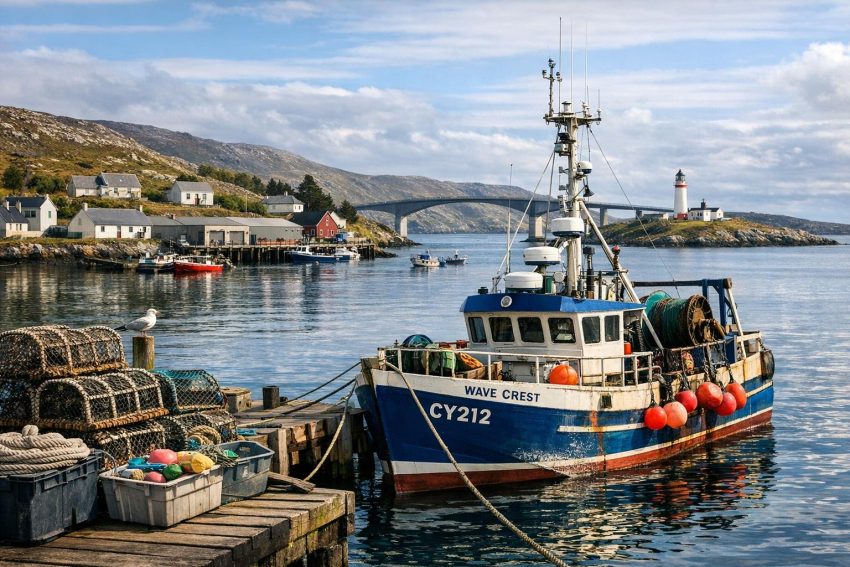
Scalpay is a small island off the east coast of Harris in the Outer Hebrides of Scotland. Known in Gaelic as An Sgalpaigh, it has long depended on the sea for food, work, transport and trade. Sheltered bays, narrow channels, rocky shores and access to the Minch gave local fishermen several types of fishing ground within reach of small boats. The same physical setting also exposed crews to strong winds, tidal streams and rapid changes in weather.
Fishing remains part of life on Scalpay, although the industry bears little resemblance to the large seasonal herring trade of the nineteenth and early twentieth centuries. Modern activity centres more on small vessels, creel fishing, shellfish handling and marine services. Boats now use diesel engines, hydraulic haulers, electronic navigation and radio communication. Catches travel by road and ferry through supply chains that may end in restaurants or wholesale markets far from the Outer Hebrides.
The island’s maritime economy reaches beyond the people who haul fishing gear. It includes boat repair, harbour maintenance, bait supply, fuel, freight transport, aquaculture support, tourism and administration. Family members may keep records, arrange collection, order gear or help prepare a vessel for the next trip. Much of this work receives little public attention, yet a fishing boat could not operate for long without it.
Scalpay’s Position in the Outer Hebrides
Scalpay lies between Harris and the open waters of the Minch. The Kyle of Scalpay separates the island from Harris, while the eastern and southern coasts face waters used by fishing boats travelling between the Outer Hebrides, Skye and the Scottish mainland. The coastline contains small inlets, rocky points and areas of sheltered water. Settlements and landing places developed where boats could approach the shore with less exposure to swell and prevailing winds.
The Minch supports several commercial fish species, including mackerel, herring, cod and haddock. Rocky seabed close to the islands provides habitat for lobster, brown crab and velvet crab. Prawns and other shellfish are found in suitable areas of softer seabed. Availability varies by season, water temperature, fishing pressure and natural changes in stock distribution.
Coastal waters around Scalpay also support seals, cetaceans, seabirds and smaller marine organisms that form the local food web. Fishermen have always worked within this biological system, even before stock surveys, catch reporting and habitat protection became part of fisheries management. Changes at one level can affect several species. A decline in small forage fish, as an example, may influence larger fish, seabirds and marine mammals.
Scalpay’s position brings access and exposure in roughly equal measure. A calm morning can turn into an awkward afternoon if wind strengthens against the tide. Reefs, skerries and narrow passages require careful boat handling. Electronic charts and satellite positioning have made navigation more accurate, but they do not replace judgement. Local crews still need to read the sea, interpret forecasts and know when staying in harbour is the sensible decision.
Tides, Wind and Working Time
Fishing hours are shaped by more than the clock. Crews consider tide, daylight, wind direction, swell and the time needed to land a catch in good condition. A weather window may allow only a short trip, particularly during winter. Boats sometimes work longer days during settled periods because poor conditions may prevent fishing later in the week.
This irregular schedule affects the rest of the supply chain. Buyers and hauliers need approximate landing times, but fishermen cannot always provide them far in advance. Repairs may also be postponed until calm weather allows gear to be recovered. On an island, one cancelled trip can have a knock-on effect on income, deliveries and customer orders.
Traditional Fishing and Household Survival
Before dependable road and ferry links, coastal households in the Hebrides combined fishing with crofting and seasonal labour. Fish provided fresh protein, while salting, drying and smoking extended storage life. Islanders could keep preserved fish for household use or exchange it for other goods. Boats also carried people, livestock, fuel and supplies between settlements.
Small open boats were suited to short coastal trips, though operating them demanded skill. Crews relied on oars or sails and planned their work around weather and tide. Fishing grounds were identified through experience, landmarks and knowledge passed between generations. Written charts had less practical value to a small-boat fisherman than familiarity with a reef, a current or a productive patch of seabed.
Methods included handlining, longlining, net fishing and creel fishing. Each method required its own gear and seasonal knowledge. Lines needed hooks, bait and regular maintenance. Nets had to be dried and repaired. Creels needed ropes, markers and bait, along with enough space ashore for stacking and repair. None of this gear was maintenance-free. Salt water has never been kind to rope, metal or timber.
Fishing income could fluctuate sharply. Poor weather reduced days at sea, while changes in fish movements affected catches. Crofting gave households another food source and some protection against weak fishing seasons. Peat cutting supplied fuel, and temporary work elsewhere brought cash into the home. This mixed pattern of employment remained common because dependence on one activity carried too much risk.
Women’s Work in the Fishing Economy
Historical accounts often focus on boat owners, skippers and catches. That emphasis leaves much shore work out of view. Women cleaned and preserved fish, repaired clothing, prepared food for crews, maintained households and managed money during absences at sea. In larger herring centres, women also worked as gutters and packers, following the seasonal fishery between ports.
On Scalpay, domestic and commercial duties often overlapped. Preparing bait, helping with sales or dealing with supplies could sit beside childcare, croft work and food preparation. Much of that labour was unpaid, or its value was absorbed into the household business. The boat brought in the catch, but a wider family operation often made the income possible.
The Herring Trade and Its Influence
Herring became one of Scotland’s major commercial fisheries during the nineteenth and early twentieth centuries. Large shoals appeared seasonally, attracting boats, merchants, processors and transport operators. The fish was salted and packed into barrels, allowing it to reach British and overseas markets before mechanical refrigeration became common.
Scalpay was not among Scotland’s largest herring ports, but its fishermen took part in the trade and benefited from nearby commercial activity. Seasonal fishing allowed crews to earn cash beyond what local subsistence work could provide. It also connected island households to merchants, larger ports and changing market prices.
The herring trade depended on far more than catching fish. Coopers made and repaired barrels. Curers purchased salt, hired workers and graded the product. Carriers moved barrels from curing stations to ships or mainland transport. Chandlers supplied rope, nets, oil and other materials. A strong fishing season created work ashore, though the work often ended as soon as the shoals moved away.
Steam-powered vessels and improved mainland railways altered fish distribution. Faster transport reduced spoilage and opened access to urban consumers. Refrigeration later changed the trade again by making fresh and frozen fish easier to move. Island ports still faced extra costs because catches had to cross stretches of sea before entering the mainland road and rail network.
Why the Herring Era Declined
The older herring economy weakened through a combination of stock changes, market shifts, industrial fishing and altered consumer demand. Shoals did not always return to the same grounds in predictable numbers. Larger powered vessels could fish farther offshore and carry more gear, placing pressure on fleets based around smaller boats.
Political and economic disruption also affected export markets. A curing station built around salted herring could not readily switch to another product if orders fell. As processing became concentrated in fewer locations, smaller ports lost associated employment. Scotland later introduced strict controls following severe stock decline, marking the end of the former open-access pattern.
For Scalpay, the change meant greater reliance on other fisheries and mixed employment. Shellfish offered one route because lobster and crab could command high prices and were suited to the rocky coastal ground. The shift did not happen overnight. Families adapted boats, gear and working arrangements over many years.
From Sail and Oar to Powered Fishing Boats
Motorisation changed the daily range of island fishermen. Engines reduced dependence on wind and gave crews more control when entering harbour or hauling gear in a tide. Boats could reach grounds faster, carry heavier equipment and return before weather deteriorated. Greater range, however, also created the temptation to remain at sea when conditions were marginal.
Wooden vessels required regular caulking, painting and structural repair. Fibreglass later became common among small fishing boats because it reduced some maintenance demands and allowed standard hull designs to be produced at scale. Timber boats did not disappear, and many remained in service for years, but new construction increasingly favoured fibreglass and steel.
Modern small vessels may carry satellite positioning equipment, chart plotters, echo sounders, radios, automatic identification equipment and emergency beacons. Hydraulic haulers reduce the physical strain of retrieving creels, though the work remains repetitive and potentially dangerous. Loose ropes, moving gear and unstable loads can cause serious accidents in seconds.
Technology helps crews identify their position and communicate with shore, but it cannot remove the basic risks of commercial fishing. Machinery can fail, electronic equipment can lose power and forecasts can be wrong. Safe operation still rests on vessel maintenance, competent boat handling, realistic trip planning and a willingness to turn back.
Creel Fishing Around Scalpay
Creel fishing is well suited to much of the seabed around the Outer Hebrides. Baited traps are set on the seabed and connected by rope to surface markers. Depending on the target catch and local practice, fishermen may set individual creels or several creels along one main line. After an interval, the boat returns and uses a hauler to bring the gear aboard.
Lobsters favour rocky ground where they can shelter, while brown crab may move across a broader range of seabed. Velvet crab is smaller but can have commercial value. Fishermen choose gear position according to depth, seabed type, season, tide and previous catch records. Precise locations often form part of a skipper’s working knowledge and are not casually shared over a cup of tea.
Once a creel reaches the boat, the crew sorts the catch. Undersized shellfish must go back into the sea. Animals in poor condition or species without a market may also be returned. Marketable shellfish need careful handling to prevent damaged claws, stress or death. Lobsters are generally banded to stop them injuring one another during storage and transport.
Creels, ropes and buoys suffer wear through regular use. Storms may move gear, cut ropes or drag fleets across rough ground. Passing vessels can accidentally tow away marker lines. Lost gear creates an economic cost and may continue catching marine life if escape gaps are absent or ineffective. Regular inspection and prompt recovery reduce that risk.
A Typical Creel-Fishing Work Cycle
A working day often begins before the vessel leaves its berth. The skipper checks the weather, tide and expected sea conditions. Fuel, bait, storage boxes, safety equipment and machinery must be ready. The crew then travels to the first set of gear, locates its marker and brings the line to the hauler.
Each creel is emptied, rebaited and returned to the sea unless it needs repair. Catch data may be recorded during or after the trip. Back in harbour, shellfish are transferred into suitable storage and prepared for collection. The boat is cleaned, gear is checked and bait is arranged for the next outing.
Bad weather does not always mean a day off. Shore time may be used to splice ropes, mend creels, service machinery, complete paperwork or order parts. A self-employed fisherman is skipper, mechanic, buyer, record keeper and safety officer rolled into one. The job description is wider than it appears from the pier.
Shellfish Quality, Storage and Sale
Much of the value in lobster and crab depends on condition rather than weight alone. Buyers expect live shellfish to arrive healthy and undamaged. Rough handling can break claws or weaken animals, while heat and poor water quality increase mortality. A catch that looked valuable aboard the boat may lose value quickly if storage fails.
Some operators use holding tanks or sea-based storage before collection. Water temperature, oxygen levels and stocking density need close attention. Shellfish also require protection during road and ferry transport. Packaging has to maintain suitable conditions without adding avoidable weight or cost.
Scalpay’s bridge connection helps catches move by road to Harris and onward through the Outer Hebrides transport network. Even so, mainland delivery remains dependent on ferry timetables and weather. Missed sailings can delay a perishable shipment. Buyers account for this risk when arranging collections and pricing island produce.
Seafood may pass through agents, wholesalers, processors and distributors before reaching the final customer. Each stage adds handling and transport costs. Direct sales can return more money to the producer, but they also create extra duties involving food rules, packaging, customer service and delivery. For many small operators, a dependable buyer remains preferable to managing retail orders from the wheelhouse.
Harbours, Piers and Working Shore Space
A harbour is both shelter and workplace. Fishing vessels need safe berths, adequate depth, lighting and road access for unloading. Crews also need places to store ropes, creels and boxes without obstructing other harbour users. Slipways and lifting facilities allow hull inspection and repair.
Older landing places were built for smaller vessels with shallower draughts. Powered boats, service vessels and visiting yachts place different demands on pontoons and quay walls. Harbour improvements may involve dredging, stronger moorings, safer access ladders and better vehicle space. Each improvement must withstand salt, storms and repeated heavy use.
Construction and repair cost more in remote areas because materials, machinery and contractors must travel farther. Tide and weather restrict working hours, and marine engineering often requires specialist staff. Routine maintenance therefore matters. A small defect left untreated can become an expensive structural problem after a winter storm.
Working shore space sometimes creates friction between users. Fishermen need room for gear and vehicles. Visiting boat crews want safe access, waste disposal and water. Kayakers may use the same launch points, while residents need clear roads and paths. Practical harbour management depends on marked storage areas, sensible rules and regular communication.
The Scalpay Bridge and Changes in Transport
The bridge between Scalpay and Harris opened in 1997. Before its construction, a ferry crossing carried residents, vehicles and supplies across the Kyle of Scalpay. The bridge gave the island permanent road access to Harris, changing everyday travel and commercial transport.
Fishing businesses benefited from easier movement of catches, bait, fuel, spare parts and vehicles. A buyer could reach the island without coordinating with the former local ferry. Residents gained better access to services, employment and shops elsewhere on Harris. Emergency travel also became more dependable.
The bridge did not reduce the economic value of the sea, but it changed its transport role. Water was no longer the only practical route off the island. Commercial fishing retained its marine base, while most household movement shifted to the road connection. Scalpay became physically easier to reach without losing its island geography.
Fishing Rules and Stock Management
Commercial fishing around Scalpay operates under licensing, vessel registration, catch reporting and gear regulations. Rules differ by species, vessel class and fishing method. Minimum landing sizes protect juvenile shellfish by requiring fishermen to return animals below the legal measurement. Restrictions may also apply to berried females, fishing effort or the design of gear.
Small inshore operators depend on local stocks year after year. That gives them a direct financial reason to avoid exhausting productive grounds. Returning undersized animals, protecting breeding stock and reducing lost gear support future catches. Voluntary restraint can help, but formal rules remain necessary where many boats share the same grounds.
Good management needs evidence from catch records, scientific sampling and observations made by working fishermen. Each source has strengths and weaknesses. Research surveys can compare stock measures over time, but they may not capture every local variation. Fishermen see day-to-day changes, though personal catch experience does not always represent the wider stock.
Disagreement often concerns how rules distribute cost. A measure that benefits stocks over several years may reduce income during the current season. Larger operators may absorb that loss more easily than a one-boat family business. Consultation works best when proposed controls are clear, evidence is available for review and affected crews have time to respond.
Marine Protected Areas and Fishing Access
Marine protected areas may safeguard seabed habitats, breeding grounds or vulnerable species. Their effect on fishing depends on the conservation target and the activities permitted within the boundary. Some areas restrict mobile gear that contacts the seabed while allowing creels. Others may impose broader controls.
Protection can help damaged habitats recover, but boundaries and enforcement require care. If fishing effort is displaced into a smaller neighbouring area, pressure may rise there. A rule also needs practical monitoring; an unenforced boundary offers little value to conservation or law-abiding fishermen.
Local involvement can improve management by identifying customary grounds, seasonal use and safe operating routes. It can also reveal where a proposal would create unintended economic effects. Conservation and fishing are not automatically opposing interests. Both rely on productive seas, though they may differ on acceptable methods and timescales.
Climate, Storms and Environmental Change
Sea temperature affects where fish feed, breed and migrate. Warmer water may shift the distribution of familiar species or alter the timing of seasonal activity. Shellfish growth and disease patterns may also change. For a small fleet tied to nearby grounds, a movement of stocks can be harder to manage than it is for vessels capable of travelling long distances.
Ocean acidification presents another concern because changes in seawater chemistry can affect organisms that build shells. The scale and timing of local effects remain difficult to predict, but shellfish businesses have a clear interest in continued monitoring. Changes in plankton, seabed communities and predator abundance may also influence commercial stocks.
Storms create a more immediate cost. Strong seas can damage piers, moorings and boats. Creels may be buried, moved or lost. Even when physical damage is avoided, repeated periods of poor weather cut fishing days and interrupt transport. Insurance covers some losses, but higher claims can contribute to higher premiums.
Adaptation may include stronger moorings, improved harbour protection, better weather data and gear designed to reduce loss. Businesses may spread effort across more than one species or combine fishing with shore-based work. Such measures reduce exposure, though they do not remove dependence on suitable weather and healthy stocks.
Aquaculture and Marine Service Work
Atlantic salmon farming forms a large part of the marine economy across the Highlands and Islands. Farms require cages, moorings, feed delivery, maintenance, fish health work and transport. Service vessels employ skippers, deck crews, engineers and technicians. Shore bases also need drivers, administrators and storage staff.
Aquaculture can provide regular wages in areas where capture fishing income varies by season. It can support marine engineering and keep workboats operating from local harbours. Employees may gain boat-handling and mechanical skills that transfer to other maritime jobs.
The industry also raises questions about coastal space, waste, parasites, fish escapes and interaction with wild salmonids. Fish farms must share water with fishing boats, ferries, recreational users and wildlife. Farm sites and vessel routes therefore require planning, monitoring and public review.
Relations between aquaculture and inshore fishing vary from place to place. Service work can provide extra income for boat operators, while farm structures may restrict access to former fishing ground. Assessment should consider the actual site, current use and likely effects rather than treating every marine business as identical.
Transport Costs and Island Business Viability
Scalpay’s bridge removes one short sea crossing, but most goods travelling to or from mainland Scotland still rely on ferries. Fuel, engines, rope, safety equipment and building materials often cost more after freight charges. A replacement part that is routine to obtain in a mainland port may take days to reach an island vessel.
Downtime carries a double cost. The repair itself costs money, and the boat earns nothing while tied up. If a mechanic must travel from outside the Outer Hebrides, accommodation and transport may be added to the invoice. Older machinery may be cheaper to purchase but harder to support when parts become scarce.
Fuel is another major expense. Small changes in price affect profit on each trip, especially where steaming time is long relative to the quantity landed. Operators cannot always pass the added cost to buyers because seafood prices are set through wider markets.
Reliable freight services help island producers meet delivery schedules and maintain buyer confidence. Ferry disruption, road closures or vehicle capacity problems can affect even a well-run fishing business. Maritime income on Scalpay therefore depends partly on infrastructure far beyond the harbour wall.
Employment, Skills and Entry into Fishing
Fishing provides self-employment and supports shore-based jobs, but entry costs are high. A new operator may need a vessel, licence access, creels, ropes, electronics, insurance and safety equipment before earning the first pound. Used gear can reduce the starting cost, though worn equipment may bring higher repair bills.
Training covers boat handling, navigation, radio use, first aid, firefighting and survival at sea. Practical learning aboard an experienced skipper’s vessel remains valuable. New entrants must learn how gear behaves in tides, how catches vary through the year and how to work safely in confined deck space.
Succession is a concern for many island industries. Younger residents may want maritime work but struggle to find housing or finance. Some leave for education and do not return because full-time employment is easier to obtain elsewhere. An ageing fleet of skippers can continue for a time, but skills may be lost if no trainees come through.
Fishing is often combined with construction, crofting, tourism, ferry work or aquaculture. This flexible pattern helps households manage seasonal income. It also makes the economic contribution of fishing harder to measure. A person recorded under another main occupation may still earn part of the year’s income from creels or boat services.
Tourism and Recreational Use of the Coast
Visitors come to Scalpay for coastal walks, wildlife, boating and the island’s cultural history. Eilean Glas Lighthouse, standing on the eastern side of Scalpay, is a recognised feature of the island and a destination for walkers. Visitor spending can support accommodation, food services, local transport and small shops.
Harbours can serve visiting yachts and recreational boats as well as the working fleet. Visitors may purchase fuel, meals and supplies or stay overnight. Kayaking and wildlife trips also draw economic value from clean water and accessible shores. Commercial fishing, tourism and conservation therefore share an interest in a well-maintained coast.
Shared use needs sensible boundaries. Fishing quays contain moving vehicles, ropes, hooks and heavy equipment. They are workplaces rather than open visitor attractions. Clear signs and designated pedestrian routes can reduce risk without excluding people from the waterfront.
Seasonal visitor traffic may put pressure on narrow roads, parking and waste services. Wildlife disturbance is another concern near breeding sites. Tourism works best when its scale matches local capacity and when operators provide accurate advice on access, tides and responsible behaviour.
Community Action and Local Control
Community bodies can support assets that private businesses may not maintain alone. Harbours, workspaces, paths, renewable energy projects and shared storage can all provide economic value without producing quick commercial returns. Local control also allows residents to set priorities based on regular use rather than distant assumptions.
A community-managed project still needs stable finance, competent administration and a maintenance plan. Grant funding may pay for construction but not future repairs. Buildings and marine structures create continuing costs after the opening ceremony is over. Long-term budgets matter as much as initial capital.
Shared facilities can lower costs for small businesses. Cold storage, gear compounds, workshop space or lifting equipment may serve several operators. Cooperation can also improve purchasing power for fuel, bait or transport. Formal arrangements are useful because informal agreements may become strained when demand is high.
Digital connectivity now supports maritime work as well. Fishermen submit records, check forecasts, order parts and communicate with buyers online. Reliable broadband and mobile coverage do not replace physical transport, but they reduce administrative delay and allow island businesses to deal directly with customers and agencies.
The Economic Outlook for Scalpay Fishing
The future of fishing on Scalpay depends on the condition of local stocks, access to markets, operating costs, regulation and the number of people prepared to work at sea. Harbour maintenance and dependable transport are just as relevant as catch levels. A productive fishing ground has little commercial value if vessels cannot berth safely or catches cannot reach a buyer.
Small-scale creel fisheries may benefit from demand for traceable seafood with a clear place of origin. Restaurants and wholesalers often value well-handled Hebridean lobster and crab. Producers can earn better returns where grading, storage and transport preserve quality. Labels and marketing claims, however, need evidence rather than vague references to island heritage.
Selective gear gives creel fishing a practical conservation advantage because undersized shellfish can often be returned alive. That does not make the method free from environmental effects. Gear density, rope use, lost creels and pressure on breeding stock still require management. Responsible fishing depends on daily practice as much as the type of gear shown on a licence.
Future businesses may combine fishing with marine contracting, boat trips, aquaculture support or shore work. Mixed income can help during poor weather and weak market periods. Diversification needs to be realistic, though. A fishing vessel is not automatically suitable for carrying passengers, and tourism brings separate insurance, safety and customer-service duties.
Scalpay’s maritime economy is best viewed as a connected chain of people, assets and services. Fishermen depend on harbours, mechanics, hauliers, buyers and ferry crews. Those services, in turn, benefit from continued marine activity. The island’s long fishing history provides knowledge and identity, but history alone will not keep boats working.
Continued fishing requires healthy coastal waters, workable rules, safe infrastructure and a fair return for the producer. It also requires housing, training and viable employment for younger residents. If those conditions are maintained, small-boat fishing can remain part of Scalpay’s economy without trying to recreate the herring fleets of the past. The methods have changed, but the practical relationship between the island and the sea remains plainly visible.