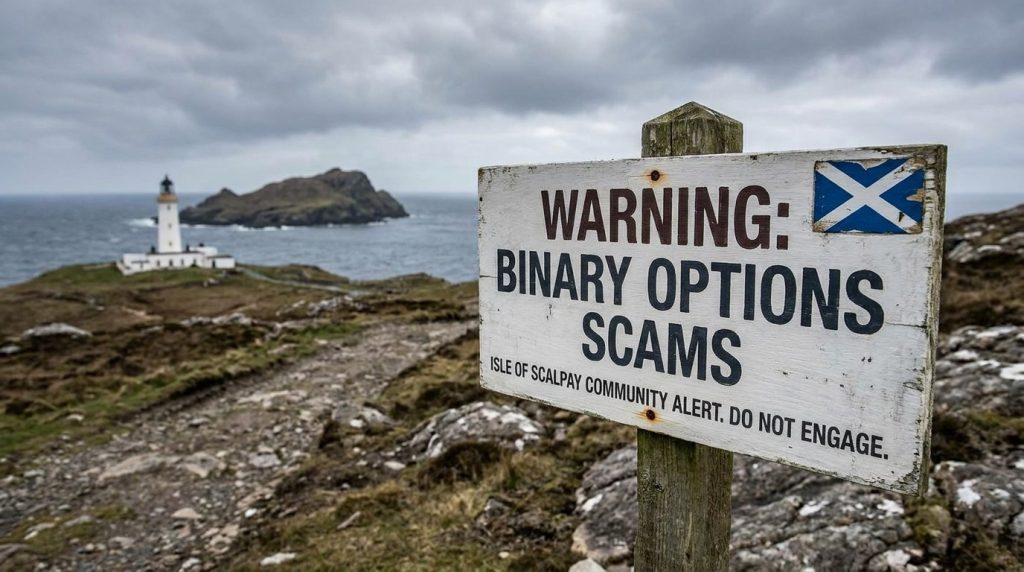
Residents of the Isle of Scalpay should be cautious about online advertisements, social media messages and unsolicited calls offering binary options trading. Scalpay’s small population and remote location do not provide any meaningful protection from internet based investment fraud. A scam operator does not need to visit Harris, know anything about the island or even be located in the UK. They can reach potential victims through Facebook, Instagram, WhatsApp, Telegram, email or an online advertisement in exactly the same way they reach someone living in Glasgow or London.
There is an important distinction to make at the start. A review of current Financial Conduct Authority, Police Scotland and wider UK fraud information does not provide evidence of a verified binary options fraud campaign aimed exclusively at Scalpay at present. The warning is therefore about the risk to Scalpay residents from a form of investment fraud that targets UK consumers online, rather than a claim that a particular criminal group has singled out the island. That distinction matters because unnecessarily alarming local residents helps nobody, but assuming remote communities will be ignored by online scammers would be equally unwise.
Binary options deserve particular attention because the UK regulatory position is unusually clear. The Financial Conduct Authority permanently prohibited the sale, marketing and distribution of binary options to UK retail consumers from 2 April 2019. The FCA’s current binary options scam guidance says that if a UK retail consumer is being offered binary options, the offer is probably a scam. The regulator also warns that fraudulent operators commonly use polished websites and social media advertising while presenting themselves as legitimate trading businesses.
For anyone on Scalpay who receives an unexpected message promising easy profits from short term market predictions, that legal position provides a useful starting point. A website claiming to be an ordinary FCA regulated UK binary options broker is not offering a clever exemption that everybody else somehow missed. UK authorised firms are prohibited from selling the product to retail consumers.
What Is a Binary Options Scam?
A binary option is based on a simple yes or no outcome. A trader might be asked whether the price of gold will be above a certain level at 3pm, whether GBP/USD will rise during the next hour or whether a stock index will finish above a stated price. If the prediction is correct, the trader receives a predetermined payout. If it is wrong, the amount committed to the contract can be lost.
That simplicity made binary options easy to sell online. A customer did not need to learn how an options chain worked or calculate the margin requirement on a futures contract. The platform could display a chart and two large buttons marked higher and lower. Unfortunately, a simple interface does not create favourable mathematics, and the retail binary options business also became closely associated with fraudulent websites and disputed withdrawals.
Readers who want to understand the mechanics of the product before assessing an offer can use BinaryOptions.net as an educational reference covering binary option contracts, payouts, expiries and the history of the market. UK residents should keep the educational material separate from the current regulatory position. Learning how a binary option works does not change the fact that FCA authorised firms cannot sell binary options to UK retail consumers.
A binary options scam goes further than simply offering a high risk product. The supposed broker may not be executing genuine trades at all. The account balance, winning positions and profits shown inside the platform can be manufactured by the operator. US regulators have received complaints involving online binary options platforms allegedly manipulating trading software, refusing to credit accounts, denying withdrawals and misusing personal information. The CFTC’s binary options fraud guidance continues to warn that many unregistered online platforms operate offshore and may be fraudulent.
That difference is worth remembering. Losing £1,000 because a genuine market moved against a position is trading risk. Depositing £1,000 with a website that never placed a real trade is fraud. The account screen may look remarkably similar in both situations.
Why Someone on Scalpay Can Still Be Targeted
The image of investment fraud as a salesman operating from an office and phoning wealthy investors from a list is increasingly outdated. Modern scams can operate almost entirely online. The fraudster can buy social media advertising, create professional looking websites, run multiple messaging accounts and collect payments without ever meeting the person whose money is being taken.
A person living on Scalpay may encounter the scam while reading news, watching a video about investing or following financial content on social media. The first advertisement may not even mention binary options. It might promote a free trading course, artificial intelligence system, market signal group or supposedly successful investor. The binary trading platform appears later, once the person has entered a private conversation.
The FCA says binary options fraudsters frequently advertise through social media before directing potential customers to professional looking websites. Fraudulent companies may also claim to have a UK presence even though they operate from overseas. This model means geography has become relatively unimportant. A scammer advertising nationally does not care whether the next person clicking the advertisement lives in Edinburgh, Stornoway, Tarbert or Scalpay.
Small communities can sometimes create a false sense that financial crime is something that happens somewhere else. Local trust is extremely valuable when people actually know one another, but internet investment fraud exists outside those community relationships. The friendly “account manager” speaking on WhatsApp may be sitting in another country and using a false name.
The person does not need to know where Scalpay is.
They only need the victim to know where the payment button is.
The Scam Often Starts With a Small Deposit
One reason binary options fraud can be persuasive is that the initial request does not always involve a large amount of money. A potential customer might be asked to deposit £100, £250 or £500 to test the platform.
The account manager then demonstrates how easy the system appears to use. Several trades produce profits. The account balance rises. The customer may receive telephone calls explaining why the market moved and how the trading strategy captured the move successfully. None of this necessarily proves that money was ever placed into a financial market.
A fraudulent platform controls the numbers shown on its own website. Turning an apparent £250 account into £400 can require nothing more than changing information in a database. Real market prices can be displayed alongside completely fictional customer trades, giving the screen an appearance of legitimacy.
The customer may then be encouraged to deposit £2,000 or £5,000 because larger accounts supposedly receive better signals, professional account management or higher payouts. Once that payment appears successful, another increase follows.
This gradual approach is psychologically effective because the customer does not feel as though they handed a stranger £10,000. They deposited £250 with a platform that appeared to work, then increased the amount after seeing apparent evidence of success.
Some fraudulent operators may even permit a small early withdrawal. Returning £100 to somebody who later deposits £20,000 can be very good business from the scammer’s perspective. A successful small withdrawal should therefore not be treated as conclusive evidence that a trading company is legitimate.
The real test comes when the customer attempts to withdraw a substantial amount without sending additional money first.
Fake Profits Can Be More Dangerous Than Fake Losses
A surprisingly effective investment scam does not show the customer losing.
It shows them winning.
Suppose a Scalpay resident deposits £2,000 after seeing a social media advertisement. Over the next month, the platform shows the account growing to £4,800. An account manager explains that gold trading has been particularly profitable and recommends increasing the account to £10,000 before an expected market event.
The customer may now be more willing to borrow, transfer savings or move money from another investment because the existing account appears to have more than doubled.
This is why a fraudulent trading account can become more dangerous as the displayed performance improves. A loss creates suspicion. A profit creates confidence.
The FCA warns that scam binary options firms may manipulate software to create false prices and payouts before closing accounts or refusing to return customers’ money. Regulators in the United States have received similar complaints. The CFTC and SEC have warned about allegations involving binary options software that distorted prices or payouts and caused winning trades to become losses.
An account balance displayed by an unverified company should therefore never be treated as proof of assets. The important questions are who holds the money, which legal company operates the platform and whether the customer can independently verify the business.
Numbers on a screen are cheap.
Recoverable money is not.
Withdrawal Problems Are a Major Warning Sign
The withdrawal stage often reveals the true nature of the operation. A customer who appears to have £15,000 in their trading account requests £5,000 back. Rather than processing the withdrawal, the company says a tax must be paid first.
The customer transfers £1,000.
A compliance fee then appears. After that, the company requires an insurance payment, verification deposit or release fee. Each new payment is presented as the final obstacle between the customer and the £15,000 balance.
This works because the apparent account value changes the victim’s judgement. Paying another £1,000 seems reasonable if doing so releases £15,000. The calculation only makes sense if the £15,000 really exists.
Fraudulent offshore trading businesses can continue inventing charges until the customer either runs out of money or realises that no withdrawal is coming. The CFTC specifically warns that unregistered offshore binary options operators can leave customers with far fewer protections when disputes occur.
A legitimate financial company can require identity verification and may have genuine withdrawal procedures. That is different from repeatedly demanding new deposits before existing customer funds can be returned. Verification requirements should be disclosed through proper account terms, and paying more money should not become a permanent condition for recovering money supposedly already held in the account.
If a company suddenly says a customer must send cryptocurrency to pay a “withdrawal tax”, suspicion should rise very quickly.
Be Careful With WhatsApp and Social Media Trading Groups
Binary options fraud can arrive through a social setting rather than a conventional investment advertisement. Someone may be invited into a WhatsApp or Telegram trading group where an administrator posts market forecasts and screenshots of profitable trades. Other members appear to confirm that the service works.
The group can seem persuasive because dozens of people apparently believe the same thing.
The difficult question is how many of those people are real independent customers.
A fraud operation can control several accounts, manufacture testimonials and create conversations designed to make a new member feel that everybody else is already earning money. The supposed customer posting a £3,000 withdrawal may be another account operated by the scammer.
Social media also allows fraudulent businesses to impersonate legitimate financial commentators, companies or public figures. The CFTC has repeatedly warned that social media is used to promote unregistered binary options businesses and other trading scams, often with fake testimonials and professional looking marketing.
Someone on Scalpay receiving an unsolicited trading message should therefore judge the underlying company rather than the person delivering the message. A pleasant conversation does not establish regulatory status. A busy Telegram group does not establish that trades are genuine, and a screenshot is not an audited financial statement.
The same rule applies if the introduction comes through someone the recipient knows. Social media accounts can be compromised, and legitimate contacts can unknowingly forward fraudulent opportunities.
Trust the person if you have reason to.
Verify the investment separately.
The UK Binary Options Ban Makes Checking an Offer Easier
Most financial scams require consumers to work out whether a firm is properly authorised for the activity being offered. Binary options in the UK are simpler because the retail product itself is prohibited.
The FCA made its permanent prohibition effective from 2 April 2019. Its formal binary options policy statement says firms carrying on relevant activity in or from the UK must not sell, market or distribute binary options to retail consumers. The regulator introduced the measure because of evidence concerning consumer losses, product characteristics and the conduct of firms selling them.
The FCA reconfirmed its position in its March 2026 perimeter report when discussing newer prediction market products. The regulator said financial prediction market contracts it had examined could amount to binary options and therefore remain subject to the permanent retail prohibition.
For someone living on Scalpay, the practical interpretation is straightforward. If a salesperson says their company is an FCA authorised retail binary options provider, do not rely on the claim. Check independently through the FCA.
A supposed licence number does not fix the problem.
A London address does not fix it either.
Scam websites have historically claimed British addresses even when the companies behind them were located elsewhere. The address may be copied from another company, relate to a mail forwarding service or simply be false.
Offshore Binary Options Platforms Create a Recourse Problem
The UK ban does not technically prevent somebody from finding an overseas website and attempting to trade there. The internet makes that easy. It also creates one of the largest risks associated with the product.
An offshore company may sit outside the practical reach of the UK financial complaints system. If the platform refuses a withdrawal, manipulates a settlement or disappears, the customer can face a complicated problem involving a company incorporated under foreign law, overseas payment routes and people whose real identities may be unknown.
The CFTC’s binary options warnings make the same point from the US perspective. Many fraudulent platforms operate offshore, where customers may have substantially fewer protections and enforcement becomes harder.
For a resident of Scalpay, dealing with an offshore binary platform can therefore create two risks at the same time. There is the ordinary probability of losing the trade, then the counterparty risk that the company controlling the account does not return money even when the customer has supposedly won.
Those risks should not be confused.
A legitimate speculative trade can have terrible odds without being fraudulent. A fraudulent platform can show excellent trading results while stealing the customer’s deposit.
The second problem is generally worse.
Requests for Personal Documents Can Create Another Problem
Trading platforms normally conduct identity checks, which makes requests for documents look ordinary. Fraudsters can exploit that expectation.
A supposed binary options broker may request a passport, driving licence, utility bill, bank statement or photographs of payment cards. The person sending the documents believes they are completing Know Your Customer procedures.
The information can potentially be used for identity fraud.
US authorities have specifically warned that fraudulent binary options websites may request copies of identity and financial documents under the pretence that regulators require them. This makes verification of the company important before sensitive documents are uploaded, not afterwards.
Anyone who has already supplied identity documents to a suspicious operator should consider the possibility that the problem extends beyond the trading deposit. Bank accounts, email accounts and credit records may need closer monitoring.
This is also why a convincing verification process does not prove that a broker is legitimate. A fraudster asking for a passport can look more professional than one who does not.
Sometimes the paperwork is part of the scam.
Recovery Scams Can Target Victims a Second Time
Losing money to a binary options scam can be followed by another approach several weeks or months later. A person claiming to represent a recovery company, lawyer, regulator or blockchain investigation service says the lost money has been located.
There is one condition.
An upfront fee must be paid before the funds can be released.
Police Scotland specifically warns victims of crypto scams that fraudsters may target them again by pretending to be organisations capable of recovering lost money and advises people not to pay such callers. The same pattern is relevant to binary options and other investment fraud because victim information can be sold or reused.
The recovery caller may know the exact name of the fraudulent platform and how much money was lost. That information can make the approach feel legitimate.
It may simply mean the caller has access to the first scam’s records.
A person who lost £8,000 is understandably motivated to recover it. That emotional pressure makes another £500 payment seem minor if someone says £8,000 is waiting.
The safer approach is to verify any recovery organisation independently and never assume that knowledge of the original fraud proves legitimacy.
Being scammed once can put somebody on a list.
What Scalpay Residents Should Do if Contacted
Someone receiving an unexpected binary options offer in Scalpay does not need to debate the salesperson about trading strategy. The UK regulatory position already provides enough reason to stop.
Do not deposit money simply to test the platform. Do not install remote access software because an account manager says they need to help configure a trading account, and do not provide identity documents until the company has been independently verified.
The FCA maintains consumer scam guidance and says consumers should use its official resources to check companies rather than relying on contact details supplied by the business itself. Its current scam protection guidance also provides a route for reporting suspected unauthorised investment firms.
Residents in Scotland should also follow Police Scotland’s reporting process. Police Scotland’s investment scam guidance advises people who believe they have fallen for an investment scam to contact their bank immediately using a trusted number and report the matter to police by calling 101.
Speed matters after a transfer. A bank may have more options when it is contacted quickly than it does after money has moved through several accounts or been converted into cryptocurrency.
Keeping evidence also helps. Messages, email addresses, telephone numbers, transaction records, screenshots and the web address of the trading platform can all be useful when reporting what happened.
Do Not Confuse Binary Options With Ordinary Investing
One reason binary options scams can work is that financial terminology lends them an appearance of investment.
Charts show recognised assets. The salesperson talks about central bank decisions, currency markets and technical analysis. The customer begins to think they are participating in the same financial system as somebody buying shares or regulated investment funds.
The structure is very different.
Buying ordinary shares means acquiring an interest in a company. A conventional bond represents a financial claim involving future payments. A binary option is a short term contingent contract in which the outcome depends on whether a defined condition is met.
Fraudulent binary websites can strip away even that economic substance. The customer may think they are trading a financial contract when the only actual transaction is money being transferred to the operator.
This is why the professionalism of the chart should carry almost no weight when judging the company. Any competent website developer can display market prices.
Regulation, legal identity and the ability to withdraw funds are harder to fake indefinitely.
A Remote Island Is Not Remote From Online Fraud
Scalpay’s geography once meant physical distance created real separation. Reaching the island required crossing water, and before the bridge opened the community depended on a ferry connection with Harris.
Online fraud has no comparable journey.
A fraudulent binary options advertisement can reach Scalpay at exactly the same time it reaches the rest of Scotland. The operator does not pay more because the potential victim lives beside the Minch. The scam does not become less convincing because Eilean Glas Lighthouse is visible a few miles away.
That is why local awareness matters even when there is no evidence of a campaign aimed specifically at Scalpay.
The appropriate warning is not that Scalpay is currently surrounded by binary options fraudsters. It is that residents should recognise a product the FCA has prohibited for UK retail sale and know what to do when an online company offers it anyway.
If a company contacts a UK retail customer promising profitable binary options trading, the starting assumption should be scepticism. If it claims FCA regulation, check that claim independently. If it requests additional payments before allowing a withdrawal, stop sending money. If money has already been transferred to a suspected scam, contact the bank promptly and report it to Police Scotland.