The Isle of Scalpay is unlikely to appear beside London, Manchester or Edinburgh in a conventional investment report. That is precisely why investing there needs to be considered differently. Scalpay is a small island connected by bridge to Harris in Scotland’s Outer Hebrides, with a permanent population measured in hundreds rather than thousands. Its economy is tied closely to Harris and the wider Western Isles, with fishing, marine activity, tourism, public services, small businesses and community projects carrying more weight than the corporate activity found in larger markets.
Investing in Scalpay can mean several different things. The most obvious route is buying residential property, either as a home, a long term rental or visitor accommodation. There are also opportunities connected with tourism, trades, marine services and small local businesses. Community organisations have been investing in housing, renewable energy and shared facilities, creating another form of investment where the intended return is partly social and economic rather than simply a percentage on capital.
None of these routes should be mistaken for easy passive income. Small island markets have thin property supply, relatively few transactions and a customer base that can change sharply between winter and summer. Repairs cost more when materials and specialist labour have to travel, while a business that appears busy in July can feel rather different in January.
The other side of that equation is scarcity. Scalpay has a permanent bridge connection with Harris, a strong maritime identity, dramatic scenery and proximity to Tarbert. There is only so much existing housing, commercial space and developable land. For an investor prepared to think in years rather than months, that combination can create opportunities, although the best investments are often those serving an identifiable local need rather than simply extracting value from scarcity.
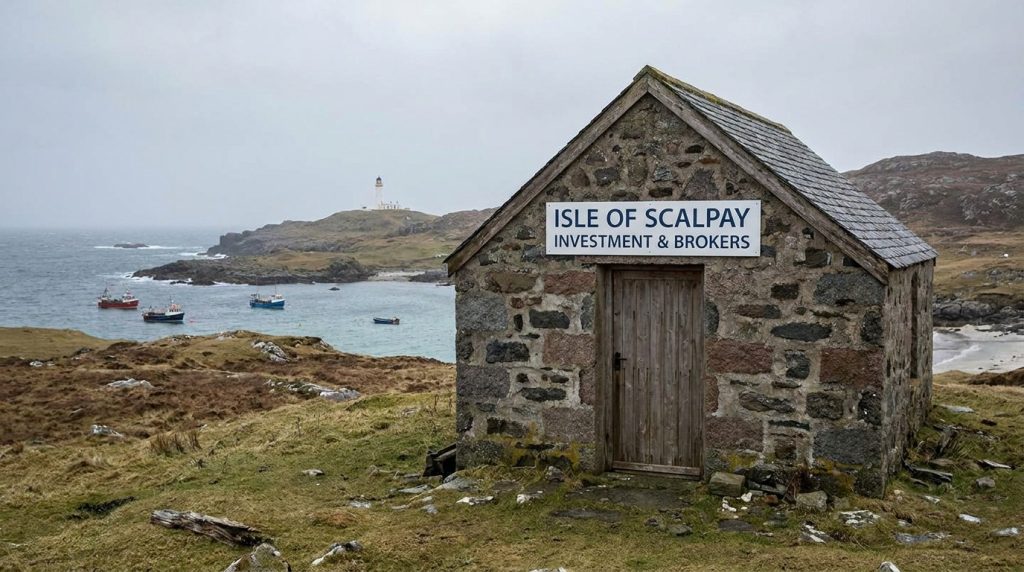
Scalpay Is a Very Small Investment Market
The first thing an investor needs to understand about Scalpay is scale. This is not simply a smaller version of a mainland property market. It behaves differently because the number of residents, houses, businesses and annual transactions is small enough that individual events can have an outsized effect.
Scalpay is physically connected to Harris by the bridge opened in 1997, but it retains a strong identity of its own. The Scottish Government’s 2026 Harris and Scalpay rural communities study identifies depopulation, shortages of affordable housing, sparse public transport and the need for more sustainable tourism among the issues affecting the area. It also describes strong community organisations and local initiatives as important parts of the response.
Those conditions create a rather different investment case from simply looking for the postcode with the fastest house price growth. Housing is an economic resource as well as an asset. A property used as a second home for a few weeks each year affects a community differently from one occupied permanently by a family, rented to a local worker or operated as a visitor business employing local people. None of those uses is automatically wrong, but their economic effects differ and local planning policy increasingly pays attention to that distinction.
Population is another factor. Scottish island data shows long running demographic pressure across parts of the Outer Hebrides, while local authority policy places retaining and increasing population near the centre of its economic objectives. The council’s current economic and community regeneration plans connect housing, employment, tourism, fisheries, renewable energy and business development with that broader population goal.
For a private investor, this means the best opportunity may be less obvious than purchasing the prettiest house overlooking the water. A property providing year round accommodation, a workshop serving marine businesses or a company solving a local service shortage may have stronger economic foundations than a project based entirely on peak summer visitors.
Residential Property Investment on Scalpay
Property is the most accessible form of direct investment on Scalpay, but it is also where investors need to be particularly careful about assumptions borrowed from larger markets. Property changes hands relatively infrequently on small islands, which makes average prices less informative. A handful of sales can distort annual figures and two neighbouring houses can have very different values because of condition, access, outlook, heating systems, outbuildings or the amount of work required.
Liquidity is one of the main risks. A house in Glasgow or Edinburgh has a large pool of potential buyers. Scalpay’s buyer pool is naturally smaller. A well maintained property with good views and practical access may attract substantial interest, especially from buyers already familiar with Harris, but there is no guarantee that it can be sold quickly when the owner needs capital. Investors should therefore avoid assuming that money placed into Scalpay property can be recovered on demand.
Condition deserves unusual attention. Older island homes can be exposed to strong winds, salt air and persistent rain, all of which are perfectly ordinary parts of Hebridean life and rather less friendly to roofs, external finishes and metalwork. Renovation budgets should include a larger contingency than investors might use on a straightforward mainland flat. Contractors and materials can also be harder to schedule, so a project expected to take four months should not be financed on the assumption that four months is an immutable law of nature.
Energy efficiency can materially affect both operating costs and marketability. Remote and island households have historically faced high fuel costs, and the local authority’s developing housing policy places energy efficient homes and reducing fuel poverty among its stated priorities. An investor considering an older property should examine insulation, glazing, heating, ventilation and the condition of the building fabric before concentrating too heavily on the view from the kitchen window.
Purchase taxation also changes the calculation for buyers acquiring an additional home. Scotland uses Land and Buildings Transaction Tax rather than Stamp Duty Land Tax. Where the Additional Dwelling Supplement applies, Revenue Scotland currently sets the ADS rate at 8% for relevant transactions entered into on or after 5 December 2024. Buyers should check the current position and any exemptions with a solicitor or tax adviser before calculating a prospective return because the upfront tax bill can materially alter the economics of a second home or rental acquisition.
Title examination matters as well. Island property can involve boundaries, access rights, private tracks, septic systems and land arrangements that deserve proper conveyancing rather than assumptions based on an estate agent’s map. If crofting tenure or croft land is involved, specialist advice becomes even more important. An investor should understand exactly what is being purchased, what rights accompany it and what restrictions affect future use before treating the property as a conventional buy to let.
Holiday Lets and Tourism Investment
Scalpay has obvious appeal as a visitor destination. It sits beside Harris, has a permanent road connection, offers access to Eilean Glas Lighthouse and provides the sort of rocky coastal scenery that photographs extremely well without requiring much assistance from the marketing department. Holiday accommodation can therefore form part of a sensible investment plan.
The mistake is assuming that attractive scenery guarantees a good accommodation business.
A holiday property needs occupancy, pricing power and manageable operating costs. Demand in the Outer Hebrides is strongly seasonal, with long summer days drawing walkers, cyclists, photographers and road trippers while winter produces a much thinner visitor market. A property achieving strong nightly rates for several summer weeks can still deliver a disappointing annual return if occupancy falls sharply during the rest of the year.
Investors also need to distinguish gross revenue from profit. Booking commissions, cleaning, laundry, electricity, heating, insurance, repairs, replacement furniture and management all sit between the advertised nightly rate and the owner’s return. A remote owner paying somebody locally to handle turnovers and emergencies will have another expense, and rightly so. A guest who discovers the heating has failed in February is unlikely to be reassured by the owner’s excellent spreadsheet in Surrey.
Regulation is now a major part of the calculation. Scotland operates a mandatory licensing regime for short term lets. Under the Scottish Government’s current short term let guidance, new operators must obtain the required licence before taking bookings or receiving guests, subject to the rules applying to their circumstances. Comhairle nan Eilean Siar operates the local licensing process and publishes fees for the Western Isles.
Planning should be checked separately from licensing because receiving a short term let licence does not necessarily answer every planning question associated with a property’s use. Buyers considering a house mainly because of projected holiday income should establish the planning and licensing position before completion rather than purchasing first and discovering the administrative details later.
The wider social effect also deserves consideration. The Scottish Government’s Harris and Scalpay research specifically identifies affordable housing pressure and the need for sustainable tourism. A visitor business is more likely to have durable local support when it contributes economically through employment, local purchasing, year round use or the restoration of a property that would otherwise remain empty. Turning scarce permanent housing into occasional visitor accommodation may produce a good private return while worsening another local problem.
That does not make holiday letting inappropriate. It means the investment needs to be considered in context.
Long Term Rental Housing
Long term rental property presents a different investment case. Instead of relying heavily on seasonal visitor demand, the owner provides accommodation to people living and working in the area. In a place facing housing shortages, that can create both economic and community value.
The challenge is that the financial return may not look as dramatic as peak season holiday rates. A long term tenant pays one agreed rent rather than a premium nightly rate during July. The property also needs to remain affordable enough for the local wage economy rather than being priced according to what a visitor will pay for a week beside the sea.
For some investors, that trade makes sense. Long term occupancy can reduce marketing expenses, cleaning costs and seasonal uncertainty. It may also reduce the amount of time required to manage the property. The owner gives up some potential peak revenue in exchange for a steadier tenancy, although void periods, repairs and tenant risk remain.
Local housing policy makes this area particularly relevant. The Outer Hebrides Housing Need and Demand Assessment is designed to guide housing supply and identifies the relationship between housing availability, population and the local economy. The council’s subsequent housing work has continued to emphasise providing enough suitable homes to retain and attract residents.
This creates a form of investment that can align private return with an obvious local requirement. It is not charitable housing unless the investor chooses to make it so. A properly purchased and managed rental can still generate income and appreciate in value while keeping a home in permanent residential use.
Investing in Local Businesses
Property is only one route into Scalpay. Small businesses can be more productive investments because they can create employment and provide services that residents and visitors would otherwise need to obtain elsewhere.
The difficulty is that Scalpay’s customer base is small. A business plan depending entirely on the island’s permanent population needs realistic assumptions about how many customers actually exist and how often they need the service. Many successful enterprises therefore need to think in terms of Harris, Lewis and the wider visitor market rather than Scalpay alone.
Practical businesses can have an advantage. Building maintenance, property management, electrical work, plumbing, marine repair, landscaping, cleaning, food production and visitor services all solve identifiable problems. Remote areas often have fewer providers, although this does not automatically mean there is enough demand for another one. The correct starting point is talking to local residents and existing businesses rather than deciding from a distance that the island desperately needs whatever company the investor happens to want to start.
Digital work changes the calculation in some cases. A small company providing professional or online services does not need to obtain every customer locally, allowing its revenue to come from outside the islands while wages and spending remain within them. This can be economically attractive because the business is not competing solely for a fixed pool of local expenditure.
Business Gateway services operated through Comhairle nan Eilean Siar provide support to start ups and existing businesses, while the local authority’s economic strategy identifies tourism, fisheries, marine resources, crofting, culture and renewable energy among sectors receiving development attention.
An investor considering Scalpay as a place to start a company should therefore look less for a fashionable sector and more for a gap that can support recurring revenue. Small islands are unforgiving places for businesses built entirely around novelty. Eventually the novelty has to pay the electricity bill.
Fishing, Aquaculture and Marine Investment
Scalpay’s fishing heritage makes marine activity one of the most obvious sectors to examine. The island’s harbours, boats and working coastline are reminders that the sea is an economic asset as well as scenery. Fishing, aquaculture and support services have all contributed to employment around Harris and Scalpay.
Direct investment in fishing is considerably more complicated than buying a holiday cottage. Vessels, licences, quotas, safety requirements, fuel, maintenance and crew all affect the economics. Inshore fishing is also dependent on stock health and regulation, so historical catches cannot simply be projected indefinitely into the future.
Aquaculture has also had an economic presence around the Outer Hebrides, including businesses connected with Scalpay. Highlands and Islands Enterprise research has previously recorded aquaculture related activity on the island and substantial salmon and shellfish employment across the Outer Hebrides.
For many investors, the more realistic opportunity may sit around the marine industry rather than inside primary fishing itself. Boat maintenance, equipment, logistics, engineering, storage and other support activities can serve commercial operators without requiring the investor to become a fisherman.
Any marine project requires its own regulatory and environmental assessment. The fact that the sea looks empty from the roadside does not mean it lacks existing users, protected interests or planning considerations.
Community Investment Is Part of the Scalpay Story
Investment on Scalpay cannot be discussed purely through private property because community ownership and locally led development play an unusually visible role.
One current example is the former Scalpay School. Harris Development Limited secured Scottish Land Fund support to acquire the site for community use, with proposals involving housing and other community facilities. The Scottish Government’s National Islands Plan annual reporting records £62,000 of support for Harris Development Limited to acquire Scalpay School for a community hub, while project material has discussed using parts of the site for secure rented housing and community purposes.
This type of investment operates differently from buying shares. The return is measured partly through housing created, services retained, buildings brought back into use and economic activity kept locally. Capital may come from grants, public funds, charitable sources and community organisations rather than investors expecting dividends.
Private investors can still participate in the same local economy. A person restoring an empty building, providing a needed commercial service or supporting a community enterprise can create a financial return while contributing to the island’s ability to retain residents.
Renewable energy provides another area where community and financial goals can overlap. The Outer Hebrides economic strategy supports community and commercial renewable energy developments and seeks to maximise the local supply chain and employment effects.
Small scale solar, heat pumps, battery systems and energy efficiency upgrades may also improve the economics of individual buildings, although every project needs to be assessed against installation cost, property condition and actual energy use. Saving £800 per year with a £40,000 installation is still an investment calculation, however green the brochure may be.
Infrastructure Is Better Than Scalpay’s Geography Suggests, but Remoteness Still Costs Money
The bridge to Harris is one of Scalpay’s strongest economic assets. It allows people, goods and services to move without an island ferry journey and gives residents direct road access to Tarbert and the wider road network of Lewis and Harris. The Scottish Government notes that the bridge connection dates from 1997, a relatively recent change in the island’s history.
That does not remove remoteness. Goods reaching Scalpay still need to reach the Outer Hebrides first, and travel between the Western Isles and mainland Scotland remains dependent on ferry and air connections. Weather, transport disruption and distance can affect deliveries, contractors and visitor numbers.
For a property developer, this translates into higher contingency requirements. Materials should be ordered with delivery risk in mind. Specialist trades may need accommodation and travel expenses. Replacement equipment can take longer to arrive than it would in a city.
For business owners, transport can affect both input costs and access to customers. A company exporting physical products has to include freight in its margins. A tourism operator needs to recognise that visitor demand depends partly on the reliability and capacity of transport links outside Scalpay itself.
Insurance also deserves early attention. Coastal and exposed properties can have different premiums and exclusions, while a building used commercially or for short term accommodation requires appropriate cover. Investors should obtain insurance quotations during due diligence rather than treating insurance as an administrative detail to arrange after the purchase.
Investing in Scalpay Without Buying Property
Not everyone interested in investing needs to own a building on the island. Direct property ownership concentrates a large amount of capital in one asset, one location and often one source of income. That concentration may suit someone who wants to live on Scalpay or operate a local business, but it is a poor fit for investors who mainly want diversified financial exposure.
UK investors comparing property with more liquid investments can use resources such as Investing.co.uk to research shares, funds, bonds and other investment products. Its material on real estate investment trusts also explains how investors can obtain property exposure through publicly traded securities rather than purchasing an individual building.
A REIT will not provide exposure specifically to Scalpay, of course. That is the trade. Financial investments offer greater diversification and usually much easier buying and selling, while direct island property provides concentrated exposure to one local market and an asset the owner can control.
An investor should be clear about which of those characteristics they actually want. Buying a Scalpay cottage because you enjoy visiting Harris is perfectly understandable, but enjoyment and investment return should still be entered in different columns of the spreadsheet.
The Main Risks of Investing in Scalpay
Scalpay’s biggest investment risks come from its size. A thin property market can make valuations uncertain and exits slow. A small local population restricts the customer base for businesses. Tourism creates seasonal income, while marine activities depend on environmental conditions, regulation and wider commodity markets.
Housing politics can also change. Scotland has already tightened regulation around short term lets and increased the Additional Dwelling Supplement on many additional residential purchases. Future planning, tax or visitor accommodation rules can alter the economics again. Investors should therefore avoid business models that only work if current regulations never change.
Physical property carries another set of risks. Wind exposure, damp, roofs, drainage, private sewage arrangements and heating all require careful examination. A cheap property requiring major work may cease to be cheap once transport and labour are included.
There is also concentration risk. Someone spending most of their available investment capital on one Scalpay house is making a substantial bet on a single property and location. A diversified portfolio of shares, bonds and funds spreads risk across many companies and markets. Direct property does not.
None of this means Scalpay is a bad place to invest. It means the required return should reflect the lack of liquidity, management burden and operational uncertainty.
An island investment should be evaluated as an island investment rather than a postcard with a mortgage attached.
Due Diligence Before Investing
The strongest Scalpay investment cases normally begin with a use rather than an asset. There should be a clear answer to the question of who will pay for the property, service or business once the investment has been made.
For residential property, that means knowing whether the likely occupier is a permanent tenant, holiday visitor or owner. Each requires a different revenue model and has different regulatory implications. Survey condition, heating, title, access, insurance, drainage and renovation costs should be examined before relying on expected appreciation.
For a holiday business, the investor should estimate occupancy month by month rather than multiplying an August nightly rate by 365. Management, cleaning, booking commissions and winter heating need to be deducted from revenue. Licensing and planning should be checked before purchase.
For a local company, demand should be established through conversations with actual customers. Scalpay is small enough that broad national market statistics are often less useful than finding out whether the people living on Harris already have three providers doing exactly what you intend to do.
Investors should also look at the wider demographic objective. The local public sector and community organisations are putting effort into retaining population, creating housing and strengthening economic resilience. Projects that employ residents, restore unused property or provide year round services are likely to fit that direction better than investments dependent on removing more assets from permanent use.
This does not require every private investor to become a community development organisation. A commercial investment still needs to make money. The point is that on an island with a small population, community conditions and private returns are unusually difficult to separate.
A thriving community supports property demand, services, visitors and businesses. A shrinking one eventually affects all four.
Is Scalpay a Good Place to Invest?
Scalpay can be a good place to invest, but it suits patient capital much better than speculative capital. There is little reason to buy property there expecting rapid turnover or effortless passive income. Transaction volumes are small, operating costs can be higher than on the mainland and tourism remains seasonal.
The stronger case is longer term. Scalpay has a permanent connection with Harris, a distinctive visitor appeal, an established maritime economy and active community development. Housing shortages create genuine demand, while tourism, marine work, property services and energy projects offer possible commercial niches. At the same time, public policy is placing more attention on whether investment helps island communities retain people and housing.
For property investors, this favours careful purchases with a clear intended use. For entrepreneurs, it favours businesses solving real problems rather than those depending only on summer footfall. For people interested in community investment, Scalpay provides examples of housing and shared infrastructure being treated as economic assets rather than simply buildings.
The island’s size is both its weakness and part of the opportunity.
There are fewer customers, fewer properties and fewer easy exits. There are also fewer places quite like it.